biologists estimate that a randomly selected baby elk has a 44% probability of surviving to adulthood…
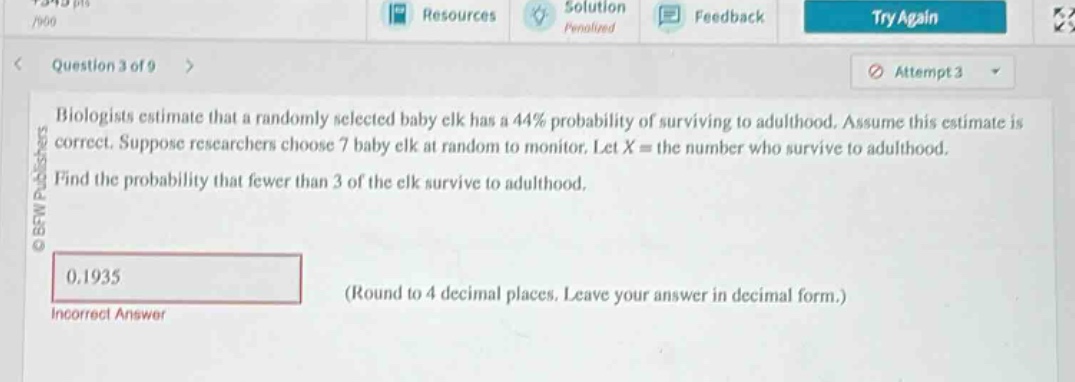
biologists estimate that a randomly selected baby elk has a 44% probability of surviving to adulthood. assume this estimate is correct. suppose researchers choose 7 baby elk at random to monitor. let ( x = ) the number who survive to adulthood. find the probability that fewer than 3 of the elk survive to adulthood. (round to 4 decimal places. leave your answer in decimal form.)
Answer
Explanation:
Step1: Identify the distribution
This is a binomial distribution problem. The binomial probability formula is (P(X = k)=C(n,k)\times p^{k}\times(1 - p)^{n - k}), where (n = 7) (number of trials), (p=0.44) (probability of success), (C(n,k)=\frac{n!}{k!(n - k)!}), and we want (P(X\lt3)=P(X = 0)+P(X = 1)+P(X = 2))
Step2: Calculate (P(X = 0))
[ \begin{align*} C(7,0)&=\frac{7!}{0!(7-0)!}=1\ P(X = 0)&=C(7,0)\times(0.44)^{0}\times(1 - 0.44)^{7-0}\ &=1\times1\times(0.56)^{7}\ &=(0.56)^{7}\approx0.0173 \end{align*} ]
Step3: Calculate (P(X = 1))
[ \begin{align*} C(7,1)&=\frac{7!}{1!(7 - 1)!}=\frac{7!}{1!6!}=7\ P(X = 1)&=C(7,1)\times(0.44)^{1}\times(0.56)^{6}\ &=7\times0.44\times(0.56)^{6}\ &\approx7\times0.44\times0.0309\ &\approx0.0951 \end{align*} ]
Step4: Calculate (P(X = 2))
[ \begin{align*} C(7,2)&=\frac{7!}{2!(7-2)!}=\frac{7\times6\times5!}{2\times1\times5!}=21\ P(X = 2)&=C(7,2)\times(0.44)^{2}\times(0.56)^{5}\ &=21\times0.1936\times(0.56)^{5}\ &\approx21\times0.1936\times0.0552\ &\approx0.2277 \end{align*} ]
Step5: Sum the probabilities
(P(X\lt3)=P(X = 0)+P(X = 1)+P(X = 2)\approx0.0173 + 0.0951+0.2277 = 0.3401)
Answer:
(0.3401)