boats from all along the atlantic coast dock at a busy marina. of the first boats to dock there one day, 6…
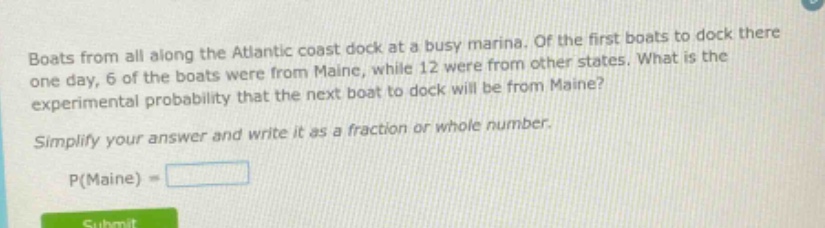
boats from all along the atlantic coast dock at a busy marina. of the first boats to dock there one day, 6 of the boats were from maine, while 12 were from other states. what is the experimental probability that the next boat to dock will be from maine? simplify your answer and write it as a fraction or whole number. p(maine) =
Answer
Explanation:
Step1: Calculate total number of boats
The number of boats from Maine is 6 and from other - states is 12. So the total number of boats is $6 + 12=18$.
Step2: Calculate experimental probability
The experimental probability $P$ (an event) is given by the number of favorable outcomes divided by the total number of outcomes. The favorable outcome is a boat from Maine, and the number of favorable outcomes is 6, and the total number of outcomes is 18. So $P(\text{Maine})=\frac{6}{18}$.
Step3: Simplify the fraction
We can simplify $\frac{6}{18}$ by dividing both the numerator and the denominator by their greatest - common divisor, which is 6. $\frac{6\div6}{18\div6}=\frac{1}{3}$.
Answer:
$\frac{1}{3}$