a box contains 24 fruit bars.\nthe probability of choosing a cherry, apple, or strawberry bar is 1.\nthe…
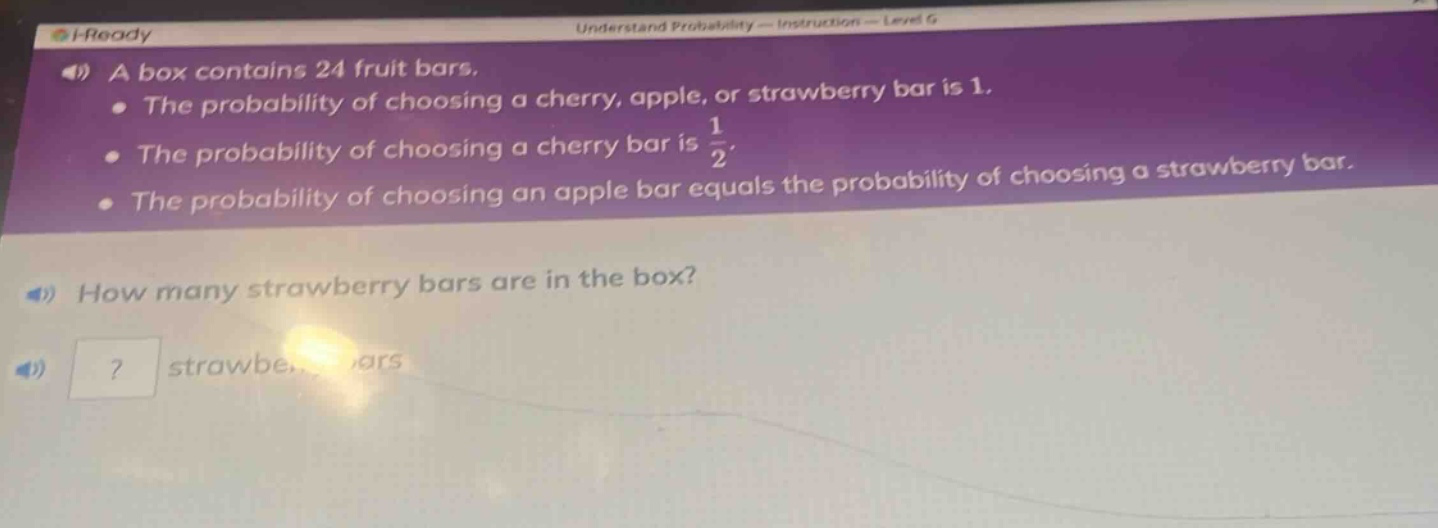
a box contains 24 fruit bars.\nthe probability of choosing a cherry, apple, or strawberry bar is 1.\nthe probability of choosing a cherry bar is $\frac{1}{2}$.\nthe probability of choosing an apple bar equals the probability of choosing a strawberry bar.\nhow many strawberry bars are in the box?
Answer
Explanation:
Step1: Determine probability of non - cherry bars
Since the probability of choosing a cherry, apple, or strawberry bar is 1 and the probability of choosing a cherry bar is $\frac{1}{2}$, the probability of choosing an apple or strawberry bar is $1-\frac{1}{2}=\frac{1}{2}$.
Step2: Calculate probability of strawberry bars
The probability of choosing an apple bar equals the probability of choosing a strawberry bar. Let the probability of choosing a strawberry bar be $P(S)$ and the probability of choosing an apple bar be $P(A)$. Since $P(A) = P(S)$ and $P(A)+P(S)=\frac{1}{2}$, then $2P(S)=\frac{1}{2}$, so $P(S)=\frac{1}{4}$.
Step3: Find number of strawberry bars
There are 24 fruit bars in total. Using the formula $n = P\times N$ (where $n$ is the number of a particular type, $P$ is the probability, and $N$ is the total number), the number of strawberry bars is $\frac{1}{4}\times24 = 6$.
Answer:
6