a box contains four red balls and eight black balls. two balls are randomly chosen from the box, and are not…
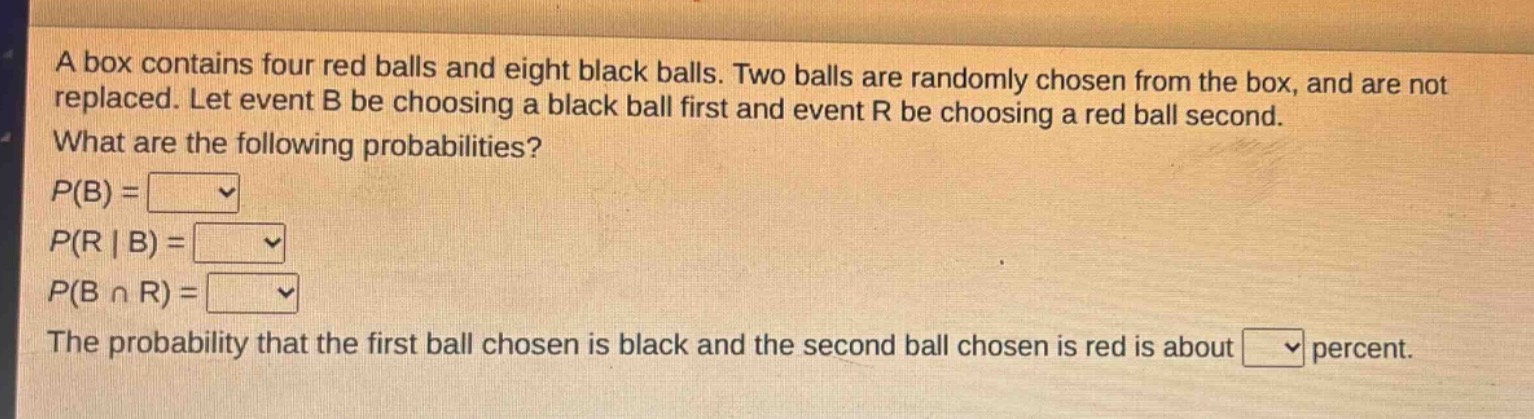
a box contains four red balls and eight black balls. two balls are randomly chosen from the box, and are not replaced. let event b be choosing a black ball first and event r be choosing a red ball second. what are the following probabilities? p(b) = p(r | b) = p(b ∩ r) = the probability that the first ball chosen is black and the second ball chosen is red is about percent.
Answer
Explanation:
Step1: Calculate P(B)
The total number of balls is $4 + 8=12$. The number of black balls is 8. So $P(B)=\frac{8}{12}=\frac{2}{3}$.
Step2: Calculate P(R|B)
If a black ball is chosen first, then there are 11 balls left and 4 red balls left. So $P(R|B)=\frac{4}{11}$.
Step3: Calculate P(B ∩ R)
By the formula $P(B\cap R)=P(B)\times P(R|B)$. Substitute $P(B)=\frac{2}{3}$ and $P(R|B)=\frac{4}{11}$ into it, we get $P(B\cap R)=\frac{2}{3}\times\frac{4}{11}=\frac{8}{33}$.
Step4: Convert P(B ∩ R) to percentage
$P(B\cap R)=\frac{8}{33}\approx 0.2424$, and in percentage it is $0.2424\times100 = 24.24%$.
Answer:
$P(B)=\frac{2}{3}$ $P(R|B)=\frac{4}{11}$ $P(B\cap R)=\frac{8}{33}$ The probability that the first ball chosen is black and the second ball chosen is red is about $24.24$ percent.