a box contains pens. some pens have ink and some do not. a teacher randomly selects a pen and sets it aside…
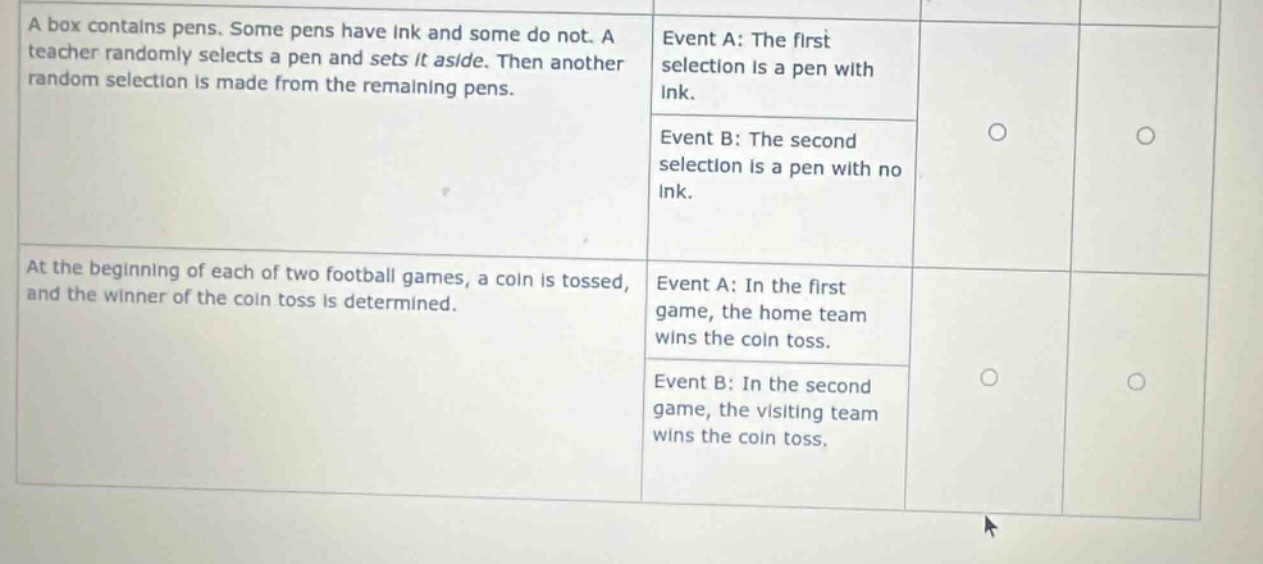
a box contains pens. some pens have ink and some do not. a teacher randomly selects a pen and sets it aside. then another random selection is made from the remaining pens.\nevent a: the first selection is a pen with ink.\nevent b: the second selection is a pen with no ink.\nat the beginning of each of two football games, a coin is tossed, and the winner of the coin toss is determined.\nevent a: in the first game, the home team wins the coin toss.\nevent b: in the second game, the visiting team wins the coin toss.
Answer
Answer:
- For the pen - selection case: Events A and B are dependent.
- For the coin - toss case: Events A and B are independent.
Explanation:
Step1: Analyze pen - selection
The first pen selection affects the number of pens with and without ink for the second selection. For example, if the first pen has ink, the proportion of pens with and without ink in the remaining set changes. So, the outcome of event A influences event B, making them dependent.
Step2: Analyze coin - toss
The result of the coin toss in the first game has no impact on the result of the coin toss in the second game. Each coin toss is an independent event with a probability of 0.5 for each outcome (heads or tails), and the outcome of one coin toss does not affect the other. So, events A and B are independent.