brand b\n47 47.5 48 48.5 49 49.5 50 50.5 51 51.5 52 52.5\nweights (grams)\nwhich statement best compares the…
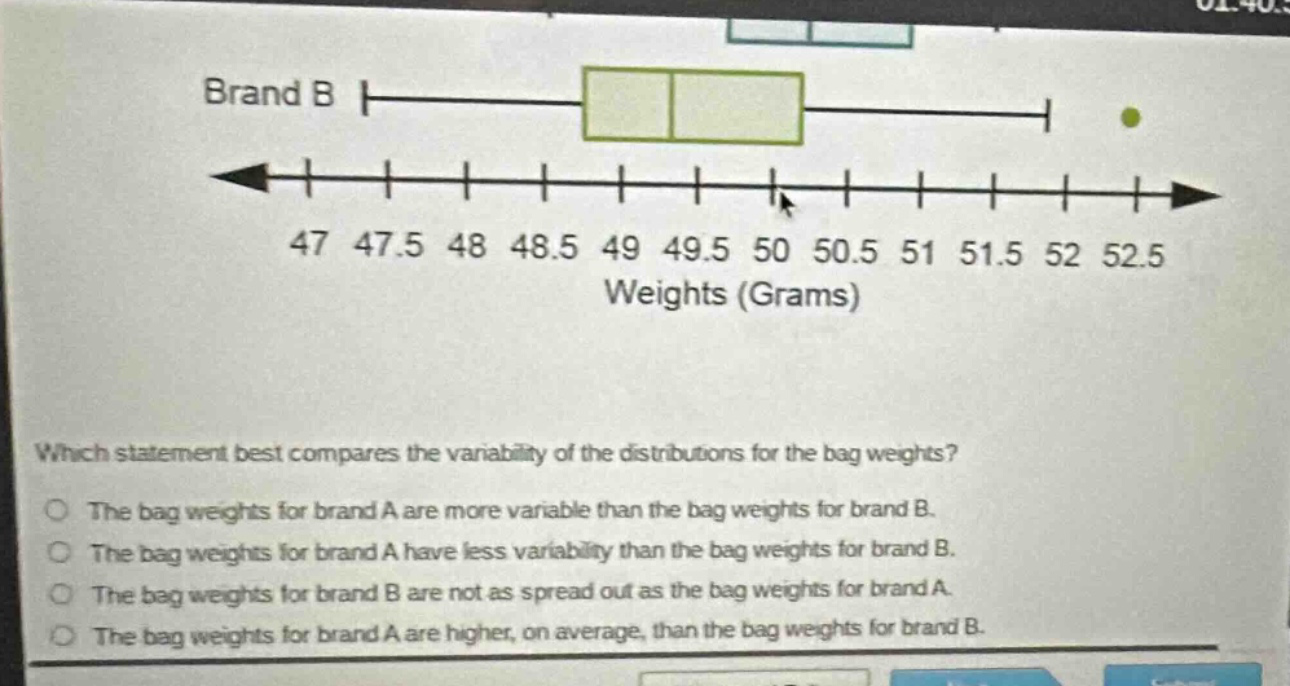
brand b\n47 47.5 48 48.5 49 49.5 50 50.5 51 51.5 52 52.5\nweights (grams)\nwhich statement best compares the variability of the distributions for the bag weights?\nthe bag weights for brand a are more variable than the bag weights for brand b.\nthe bag weights for brand a have less variability than the bag weights for brand b.\nthe bag weights for brand b are not as spread out as the bag weights for brand a.\nthe bag weights for brand a are higher, on average, than the bag weights for brand b.
Answer
Answer:
A. The bag weights for brand A are more variable than the bag weights for brand B.
Explanation:
Step1: Identify variability measure in boxplots
Variability is determined by spread (range/IQR).
Step2: Compare spreads between brands
If Brand A's boxplot shows a wider spread (longer box/whiskers) than Brand B's, it has more variability.
Step3: Evaluate options
Option A states higher variability for A, aligning with greater spread; other options either discuss central tendency (D) or incorrect spread comparison (B, C).