caitlyn calculated the probability of the complement of rolling a number greater than 2 on a 6 - side number…
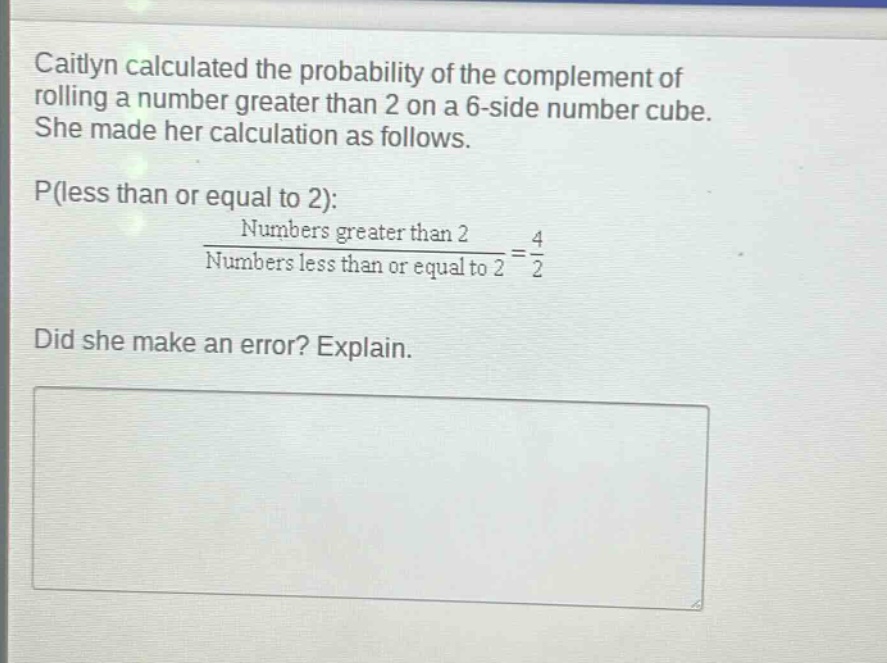
caitlyn calculated the probability of the complement of rolling a number greater than 2 on a 6 - side number cube. she made her calculation as follows. p(less than or equal to 2): numbers greater than 2 / numbers less than or equal to 2 = 4 / 2. did she make an error? explain.
Answer
Explanation:
Step1: Identify total outcomes
A 6 - sided number cube has 6 possible outcomes.
Step2: Determine favorable outcomes for "less than or equal to 2"
The numbers less than or equal to 2 on a 6 - sided cube are 1 and 2, so there are 2 favorable outcomes.
Step3: Calculate probability correctly
The probability $P(\text{less than or equal to }2)=\frac{\text{Number of favorable outcomes}}{\text{Total number of outcomes}}=\frac{2}{6}=\frac{1}{3}$.
Step4: Analyze Caitlyn's error
Caitlyn divided the number of numbers greater than 2 (4) by the number of numbers less than or equal to 2 (2). The correct way is to divide the number of numbers less than or equal to 2 by the total number of outcomes.
Answer:
Yes, she made an error. She used the wrong ratio for calculating the probability. The correct probability of rolling a number less than or equal to 2 on a 6 - sided number cube is $\frac{1}{3}$, not $\frac{4}{2}$.