calculating and comparing probabilities\na veterinarian surveys her clients and finds that 32 percent of the…
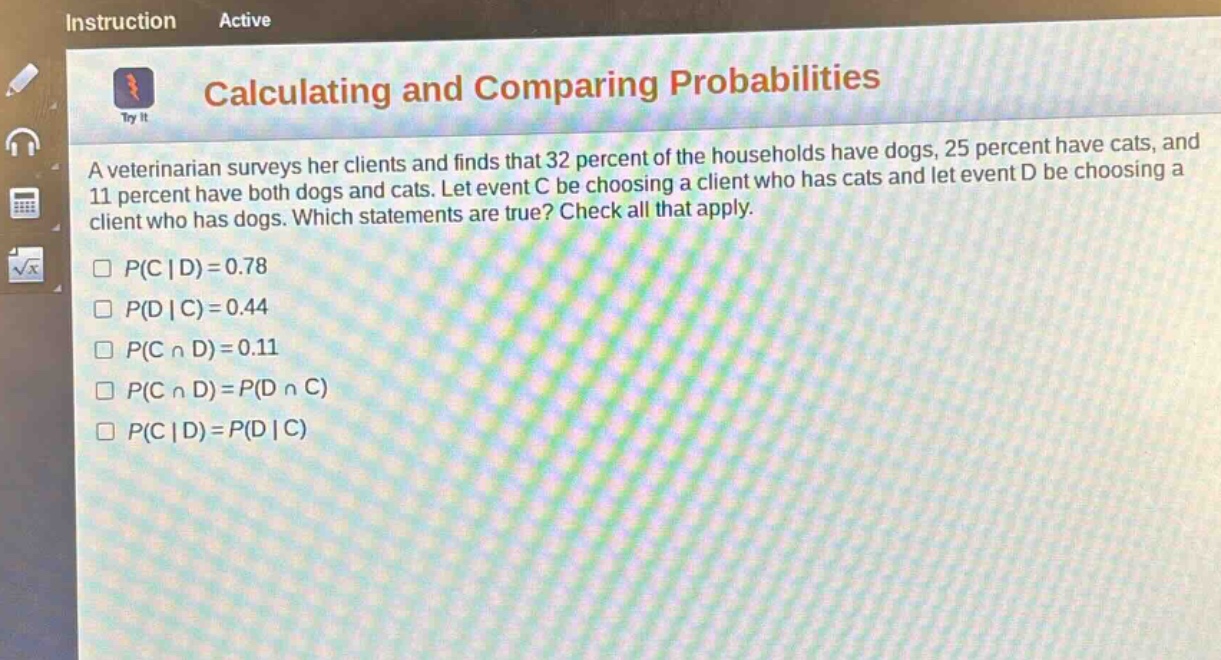
calculating and comparing probabilities\na veterinarian surveys her clients and finds that 32 percent of the households have dogs, 25 percent have cats, and 11 percent have both dogs and cats. let event c be choosing a client who has cats and let event d be choosing a client who has dogs. which statements are true? check all that apply.\n□ p(c | d)=0.78\n□ p(d | c)=0.44\n□ p(c ∩ d)=0.11\n□ p(c ∩ d)=p(d ∩ c)\n□ p(c | d)=p(d | c)
Answer
Explanation:
Step1: Recall probability - formula for conditional probability
The formula for conditional probability is $P(A|B)=\frac{P(A\cap B)}{P(B)}$. Also, $P(A\cap B) = P(B\cap A)$ by the commutative property of intersection. Given $P(C) = 0.25$, $P(D)=0.32$, and $P(C\cap D)=0.11$.
Step2: Calculate $P(C|D)$
$P(C|D)=\frac{P(C\cap D)}{P(D)}=\frac{0.11}{0.32}\approx0.344$.
Step3: Calculate $P(D|C)$
$P(D|C)=\frac{P(D\cap C)}{P(C)}=\frac{0.11}{0.25} = 0.44$.
Step4: Analyze the properties of intersection
By the commutative property of intersection of events, $P(C\cap D)=P(D\cap C)$.
Answer:
B. $P(D|C)=0.44$ C. $P(C\cap D)=0.11$ D. $P(C\cap D)=P(D\cap C)$