calculating theoretical probability\nfour numbers from the set 0 to 9, including 0 and 9, are used to create…
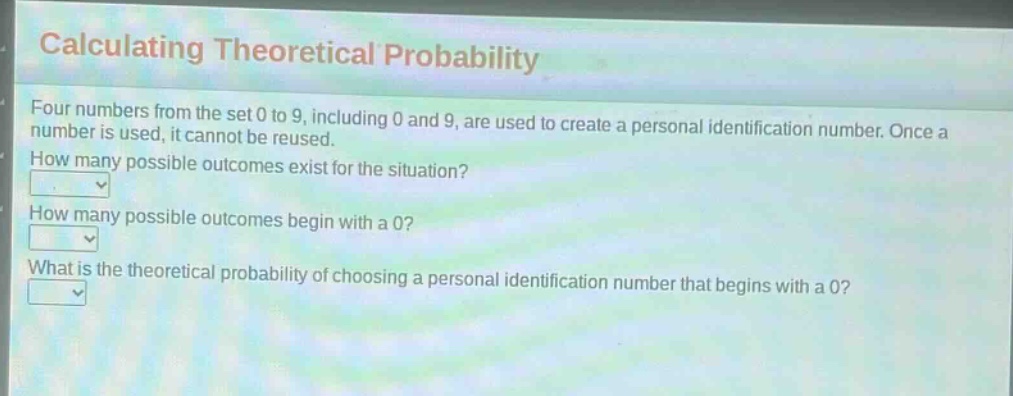
calculating theoretical probability\nfour numbers from the set 0 to 9, including 0 and 9, are used to create a personal identification number. once a number is used, it cannot be reused.\nhow many possible outcomes exist for the situation?\nhow many possible outcomes begin with a 0?\nwhat is the theoretical probability of choosing a personal identification number that begins with a 0?
Answer
Explanation:
Step1: Calculate total possible outcomes
We use the permutation formula (P(n,r)=\frac{n!}{(n - r)!}), where (n = 10) (numbers from 0 - 9) and (r=4). So (P(10,4)=\frac{10!}{(10 - 4)!}=\frac{10!}{6!}=10\times9\times8\times7 = 5040).
Step2: Calculate outcomes starting with 0
If the first - digit is 0, then we need to choose 3 numbers from the remaining 9 numbers. Using the permutation formula with (n = 9) and (r = 3), (P(9,3)=\frac{9!}{(9 - 3)!}=\frac{9!}{6!}=9\times8\times7=504).
Step3: Calculate the probability
The probability (P) of an event is given by (P=\frac{\text{Number of favorable outcomes}}{\text{Total number of outcomes}}). So (P=\frac{504}{5040}=\frac{1}{10}=0.1).
Answer:
How many possible outcomes exist for the situation? 5040 How many possible outcomes begin with a 0? 504 What is the theoretical probability of choosing a personal identification number that begins with a 0? 0.1