at a carnival booth, 14 people won a prize and 21 people did not. what is the experimental probability that…
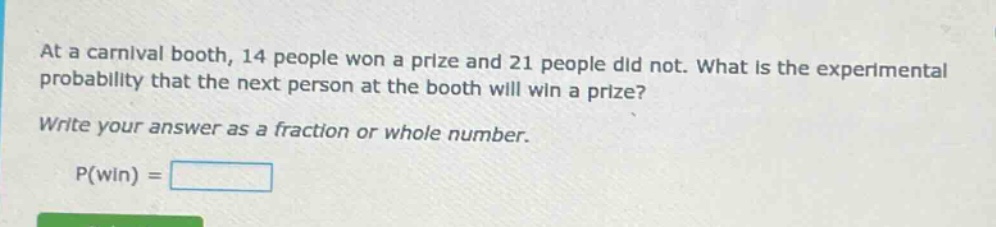
at a carnival booth, 14 people won a prize and 21 people did not. what is the experimental probability that the next person at the booth will win a prize? write your answer as a fraction or whole number. p(win) =
Answer
Explanation:
Step1: Calculate total number of people
The total number of people is the sum of those who won and those who didn't. So, $14 + 21=35$.
Step2: Calculate experimental - probability
The experimental probability $P(\text{win})$ of winning a prize is the number of people who won divided by the total number of people. So, $P(\text{win})=\frac{14}{35}$.
Step3: Simplify the fraction
$\frac{14}{35}=\frac{2}{5}$ by dividing both the numerator and denominator by 7.
Answer:
$\frac{2}{5}$