categorizing relationships between variables\nwhich scenarios have a negative correlation? check all that…
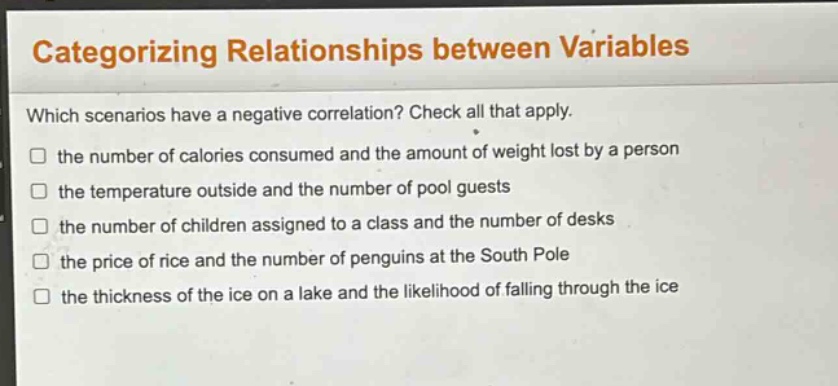
categorizing relationships between variables\nwhich scenarios have a negative correlation? check all that apply.\n□ the number of calories consumed and the amount of weight lost by a person\n□ the temperature outside and the number of pool guests\n□ the number of children assigned to a class and the number of desks\n□ the price of rice and the number of penguins at the south pole\n□ the thickness of the ice on a lake and the likelihood of falling through the ice
Answer
Explanation:
Step1: Analyze calorie - weight relationship
As the number of calories consumed increases, the amount of weight lost generally decreases, so it has a negative correlation.
Step2: Analyze temperature - pool guests relationship
As the temperature outside increases, the number of pool guests usually increases, so it has a positive correlation.
Step3: Analyze children - desks relationship
As the number of children assigned to a class increases, the number of desks needed increases, so it has a positive correlation.
Step4: Analyze rice price - penguin number relationship
There is no logical relationship between the price of rice and the number of penguins at the South Pole.
Step5: Analyze ice thickness - falling likelihood relationship
As the thickness of the ice on a lake increases, the likelihood of falling through the ice decreases, so it has a negative correlation.
Answer:
the number of calories consumed and the amount of weight lost by a person, the thickness of the ice on a lake and the likelihood of falling through the ice