a cell phone company randomly selected 250 of its 4,238 users of the model m384 phone for a poll. the…
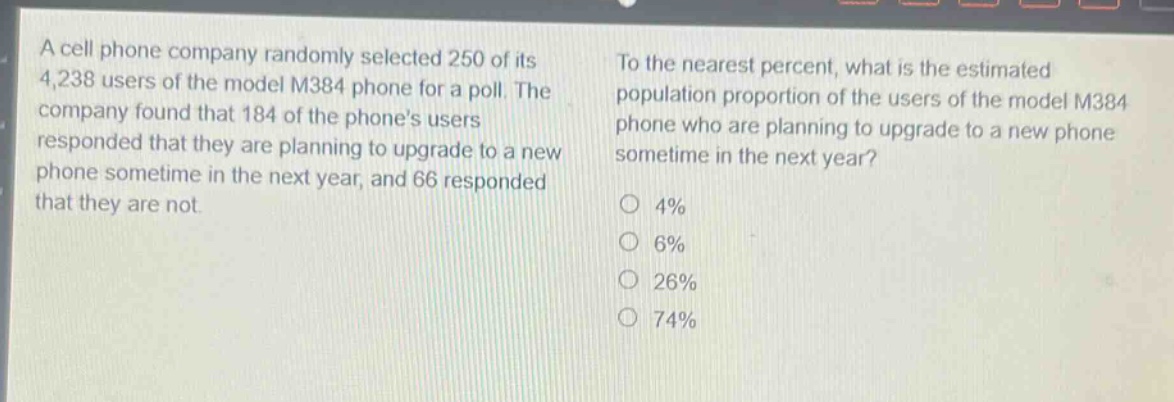
a cell phone company randomly selected 250 of its 4,238 users of the model m384 phone for a poll. the company found that 184 of the phones users responded that they are planning to upgrade to a new phone sometime in the next year, and 66 responded that they are not. to the nearest percent, what is the estimated population proportion of the users of the model m384 phone who are planning to upgrade to a new phone sometime in the next year? 4% 6% 26% 74%
Answer
Explanation:
Step1: Identify the formula for proportion
The formula for sample - proportion $\hat{p}=\frac{x}{n}$, where $x$ is the number of successes in the sample and $n$ is the sample size.
Step2: Determine the values of $x$ and $n$
Here, $x = 184$ (number of users planning to upgrade) and $n=250$ (sample size).
Step3: Calculate the sample - proportion
$\hat{p}=\frac{184}{250}=0.736$.
Step4: Convert to percentage
To convert the proportion to a percentage, multiply by 100. So, $0.736\times100 = 73.6%$.
Step5: Round to the nearest percent
Rounding $73.6%$ to the nearest percent gives $74%$.
Answer:
74%