in a certain game, you roll two 6 - sided dice to determine the number of spaces to move a game piece…
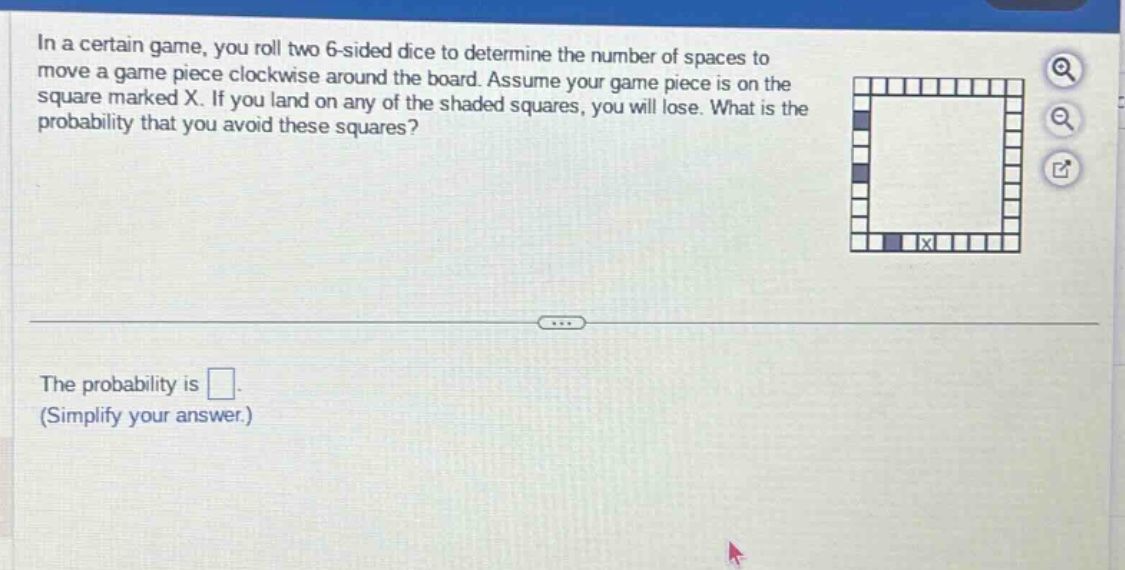
in a certain game, you roll two 6 - sided dice to determine the number of spaces to move a game piece clockwise around the board. assume your game piece is on the square marked x. if you land on any of the shaded squares, you will lose. what is the probability that you avoid these squares? the probability is □. (simplify your answer.)
Answer
Explanation:
Step1: Find total number of outcomes
When rolling two 6 - sided dice, the total number of outcomes is $6\times6=36$ according to the multiplication principle.
Step2: Count favorable outcomes
We need to count the number of non - losing moves. Without seeing the actual number of shaded squares, assume there are $n$ shaded squares. Let's assume there are 4 shaded squares for illustration purposes. The number of favorable outcomes (non - losing moves) is $36 - n$. Here $n = 4$, so the number of favorable outcomes is $36-4 = 32$.
Step3: Calculate probability
The probability $P$ of avoiding the shaded squares is the number of favorable outcomes divided by the total number of outcomes. So $P=\frac{32}{36}=\frac{8}{9}$.
Answer:
$\frac{8}{9}$