a certain size of tires is supposed to be inflated to 35 psi. the owner of a vehicle repair shop would like…
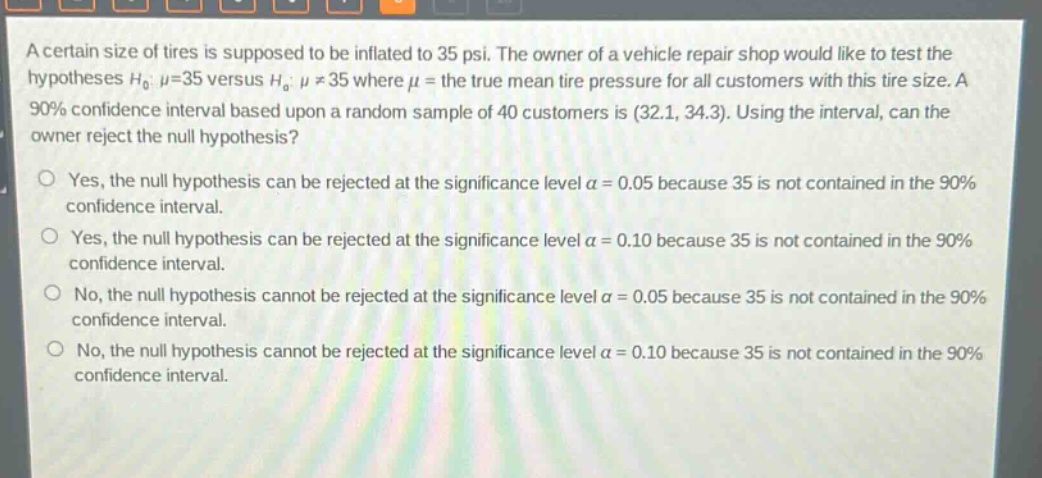
a certain size of tires is supposed to be inflated to 35 psi. the owner of a vehicle repair shop would like to test the hypotheses $h_0: mu = 35$ versus $h_a: mu\neq35$ where $mu$ = the true mean tire pressure for all customers with this tire size. a 90% confidence interval based upon a random sample of 40 customers is (32.1, 34.3). using the interval, can the owner reject the null hypothesis?\nyes, the null hypothesis can be rejected at the significance level $alpha = 0.05$ because 35 is not contained in the 90% confidence interval.\nyes, the null hypothesis can be rejected at the significance level $alpha = 0.10$ because 35 is not contained in the 90% confidence interval.\nno, the null hypothesis cannot be rejected at the significance level $alpha = 0.05$ because 35 is not contained in the 90% confidence interval.\nno, the null hypothesis cannot be rejected at the significance level $alpha = 0.10$ because 35 is not contained in the 90% confidence interval.
Answer
Explanation:
Step1: Recall confidence - interval and hypothesis - testing relationship
A 90% confidence interval corresponds to a two - tailed test with significance level $\alpha=1 - 0.90 = 0.10$. If the hypothesized value of the population mean under the null hypothesis ($\mu_0$) is not in the confidence interval, we reject the null hypothesis.
Step2: Analyze the given values
The null hypothesis is $H_0:\mu = 35$, and the 90% confidence interval is $(32.1,34.3)$. The value 35 is not in the interval $(32.1,34.3)$. Since the confidence level is 90% (significance level $\alpha = 0.10$), we can reject the null hypothesis at the significance level $\alpha=0.10$.
Answer:
Yes, the null hypothesis can be rejected at the significance level $\alpha = 0.10$ because 35 is not contained in the 90% confidence interval.