choose the relationship that best describes each set of variables.\n| variables | relationship…
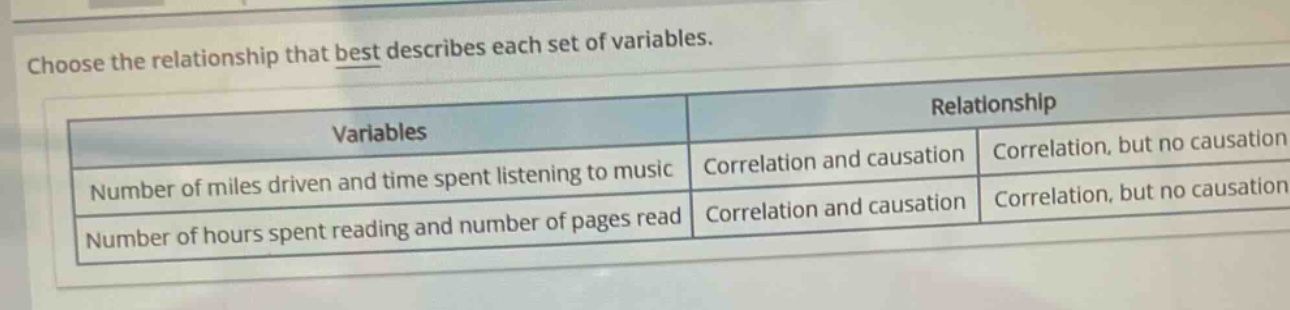
choose the relationship that best describes each set of variables.\n| variables | relationship |\n|--|--|--|--|\n| number of miles driven and time spent listening to music | correlation and causation | correlation, but no causation |\n| number of hours spent reading and number of pages read | correlation and causation | correlation, but no causation |
Answer
Explanation:
Step1: Analyze miles - music relationship
Driving more miles doesn't directly cause more music - listening time. There could be a correlation (e.g., longer drives might mean more music - listening), but no causation. So, for "Number of miles driven and time spent listening to music", the relationship is correlation, but no causation.
Step2: Analyze reading - pages relationship
The more hours one spends reading, generally the more pages one will read. There is both a correlation (as one variable changes, the other changes) and a causation (the act of spending more time reading causes more pages to be read). So, for "Number of hours spent reading and number of pages read", the relationship is correlation and causation.
Answer:
Number of miles driven and time spent listening to music: Correlation, but no causation Number of hours spent reading and number of pages read: Correlation and causation