chuck wants to know which brand of tire, a or b, lasts longer on cars. he chooses 32 cars and puts brand a…
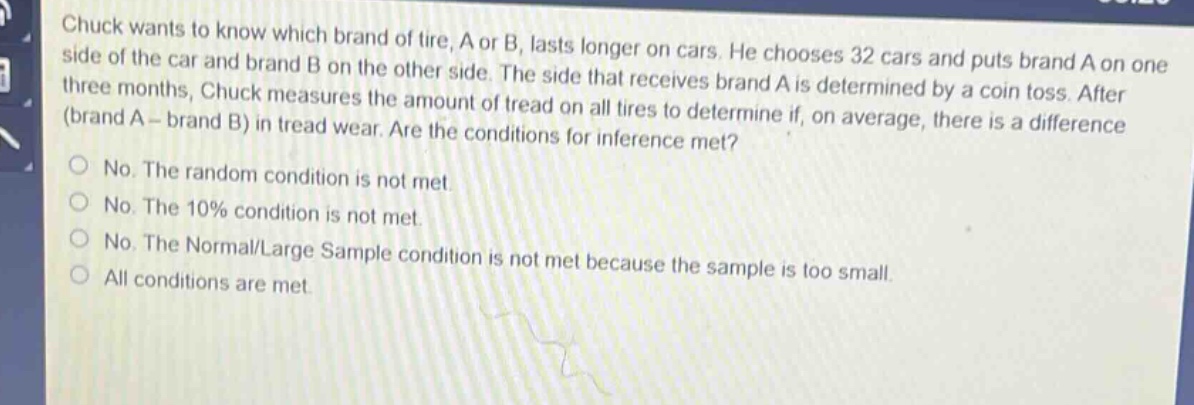
chuck wants to know which brand of tire, a or b, lasts longer on cars. he chooses 32 cars and puts brand a on one side of the car and brand b on the other side. the side that receives brand a is determined by a coin toss. after three months, chuck measures the amount of tread on all tires to determine if, on average, there is a difference (brand a - brand b) in tread wear. are the conditions for inference met?\nno. the random condition is not met.\nno. the 10% condition is not met.\nno. the normal/large sample condition is not met because the sample is too small.\nall conditions are met.
Answer
Brief Explanations:
- Random condition: The side of the car that gets brand A is determined by a coin - toss, so the assignment of tires to the sides of the cars is random.
- 10% condition: We can assume that there are more than 320 cars (since 32 is 10% of 320), so the 10% condition is met.
- Normal/Large - Sample condition: A sample size of (n = 32) is considered a reasonably large sample. For a one - sample or paired - sample t - test (which is relevant here for comparing the two tire brands on the same cars), a sample size of 30 or more is often sufficient for the Central Limit Theorem to apply, assuming the data is not extremely skewed. Since all these conditions are met.
Answer:
All conditions are met.