a chunk of basalt has been analyzed using the k40 to ar40 radio decay m. after analysis it was determined…
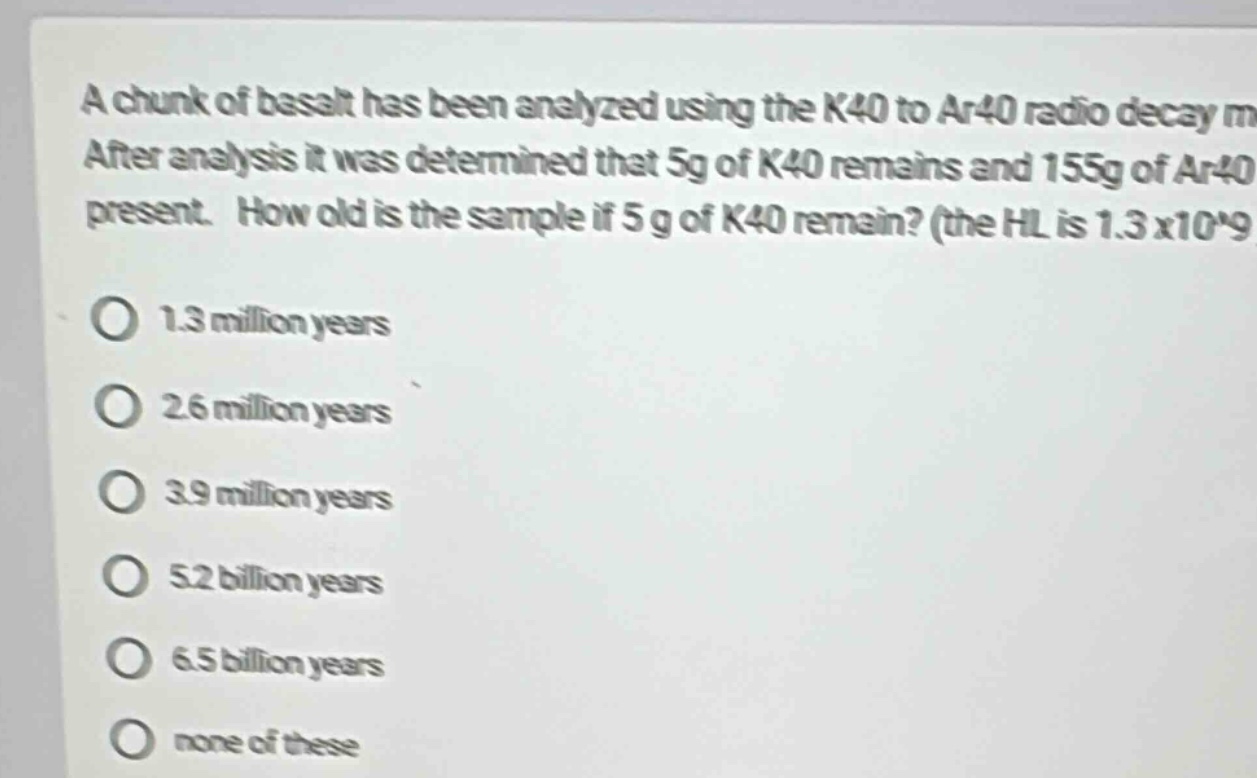
a chunk of basalt has been analyzed using the k40 to ar40 radio decay m. after analysis it was determined that 5g of k40 remains and 155g of ar40 present. how old is the sample if 5 g of k40 remain? (the hl is 1.3 x10^9\n\no 1.3 million years\n\no 2.6 million years\n\no 3.9 million years\n\no 5.2 billion years\n\no 6.5 billion years\n\no none of these
Answer
Explanation:
Step1: Calculate initial amount of K - 40
The amount of Ar - 40 is formed from the decay of K - 40. The initial amount of K - 40 ($N_0$) is the sum of the remaining K - 40 ($N$) and the amount of K - 40 that decayed to form Ar - 40. Since the amount of Ar - 40 is 155g and remaining K - 40 is 5g, $N_0=155 + 5=160$g.
Step2: Determine number of half - lives ($n$)
The formula for radioactive decay is $N = N_0(\frac{1}{2})^n$. We know $N = 5$g and $N_0 = 160$g. Substituting these values into the formula gives $5=160(\frac{1}{2})^n$. Then $\frac{5}{160}=(\frac{1}{2})^n$, and $\frac{1}{32}=(\frac{1}{2})^n$. Since $\frac{1}{32}=(\frac{1}{2})^5$, $n = 5$.
Step3: Calculate age of the sample ($t$)
The half - life ($T_{1/2}$) is $1.3\times10^9$ years. The age of the sample $t=n\times T_{1/2}$. Substituting $n = 5$ and $T_{1/2}=1.3\times10^9$ years, we get $t = 5\times1.3\times10^9=6.5\times10^9$ years or 6.5 billion years.
Answer:
6.5 billion years