a citys annual rainfall totals are normally distributed, and the probability that the city gets more than…
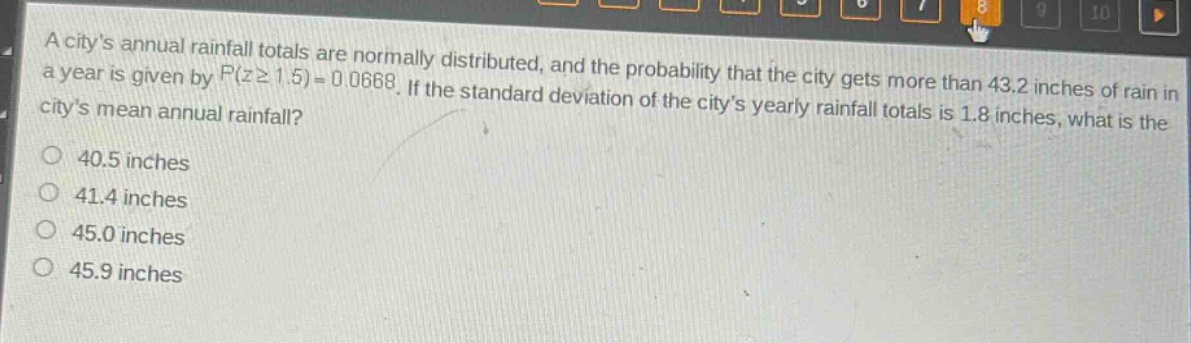
a citys annual rainfall totals are normally distributed, and the probability that the city gets more than 43.2 inches of rain in a year is given by $p(zgeq1.5)=0.0668$. if the standard deviation of the citys yearly rainfall totals is 1.8 inches, what is the citys mean annual rainfall?\n40.5 inches\n41.4 inches\n45.0 inches\n45.9 inches
Answer
Explanation:
Step1: Recall z - score formula
The z - score formula is $z=\frac{x-\mu}{\sigma}$, where $x$ is the value from the data set, $\mu$ is the mean, and $\sigma$ is the standard deviation. We know that $P(z\geq1.5) = 0.0668$, and we are given $x = 43.2$ inches and $\sigma=1.8$ inches. We want to find $\mu$.
Step2: Rearrange the z - score formula for $\mu$
Starting from $z=\frac{x - \mu}{\sigma}$, we can multiply both sides by $\sigma$: $z\sigma=x-\mu$. Then, we can solve for $\mu$: $\mu=x - z\sigma$.
Step3: Substitute the known values
We know that $z = 1.5$, $x = 43.2$ inches, and $\sigma = 1.8$ inches. Substituting these values into the formula $\mu=x - z\sigma$, we get $\mu=43.2-1.5\times1.8$.
Step4: Calculate the value of $\mu$
First, calculate $1.5\times1.8 = 2.7$. Then, $\mu=43.2 - 2.7=40.5$ inches.
Answer:
40.5 inches