in a class of students, the following data table summarizes the gender of the students and whether they have…
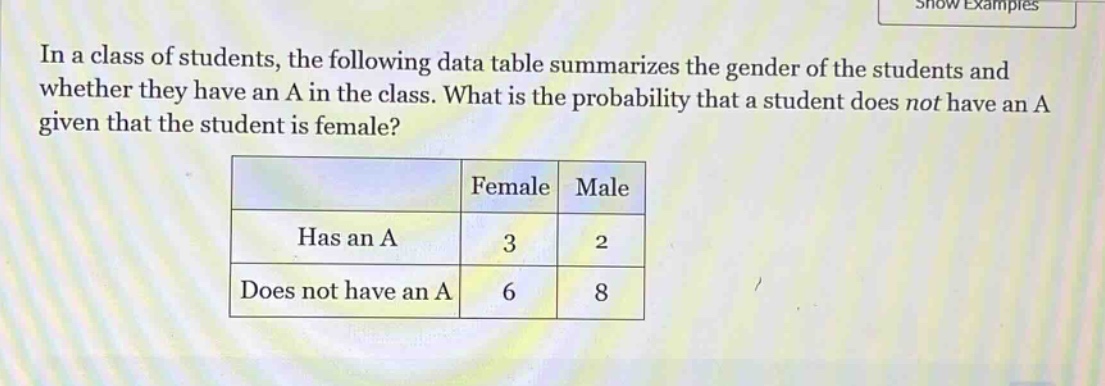
in a class of students, the following data table summarizes the gender of the students and whether they have an a in the class. what is the probability that a student does not have an a given that the student is female?\n| |female|male|\n|--|--|--|\n|has an a|3|2|\n|does not have an a|6|8|
Answer
Explanation:
Step1: Identify relevant numbers
We want the probability that a student does not have an A given female. The number of females who do not have an A is 6, and the total number of females is (3 + 6=9).
Step2: Calculate the conditional - probability
The formula for conditional probability (P(B|A)=\frac{P(A\cap B)}{P(A)}). In the case of frequency - based probability, if (A) is the event of being female and (B) is the event of not having an A, then (P(B|A)=\frac{n(A\cap B)}{n(A)}), where (n(A\cap B)) is the number of females who do not have an A and (n(A)) is the total number of females. So the probability is (\frac{6}{9}=\frac{2}{3}).
Answer:
(\frac{2}{3})