in a class of students, the following data table summarizes how many students have a brother or a sister…
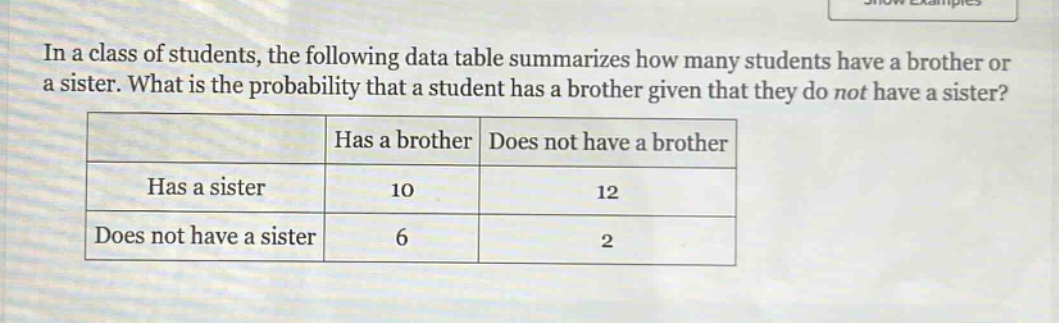
in a class of students, the following data table summarizes how many students have a brother or a sister. what is the probability that a student has a brother given that they do not have a sister?\n| |has a brother|does not have a brother|\n|--|--|--|\n|has a sister|10|12|\n|does not have a sister|6|2|
Answer
Explanation:
Step1: Recall conditional - probability formula
The formula for conditional probability is $P(A|B)=\frac{P(A\cap B)}{P(B)}$. In terms of counts, if $A$ is the event of having a brother and $B$ is the event of not having a sister, then $P(A|B)=\frac{n(A\cap B)}{n(B)}$, where $n(A\cap B)$ is the number of students who have a brother and do not have a sister, and $n(B)$ is the number of students who do not have a sister.
Step2: Identify the relevant counts
From the table, the number of students who have a brother and do not have a sister $n(A\cap B) = 6$. The number of students who do not have a sister $n(B)=6 + 2=8$.
Step3: Calculate the probability
$P(A|B)=\frac{n(A\cap B)}{n(B)}=\frac{6}{8}=\frac{3}{4}$
Answer:
$\frac{3}{4}$