claudias calculator will generate random numbers. she sets it to generate a number from 1 to 5 one hundred…
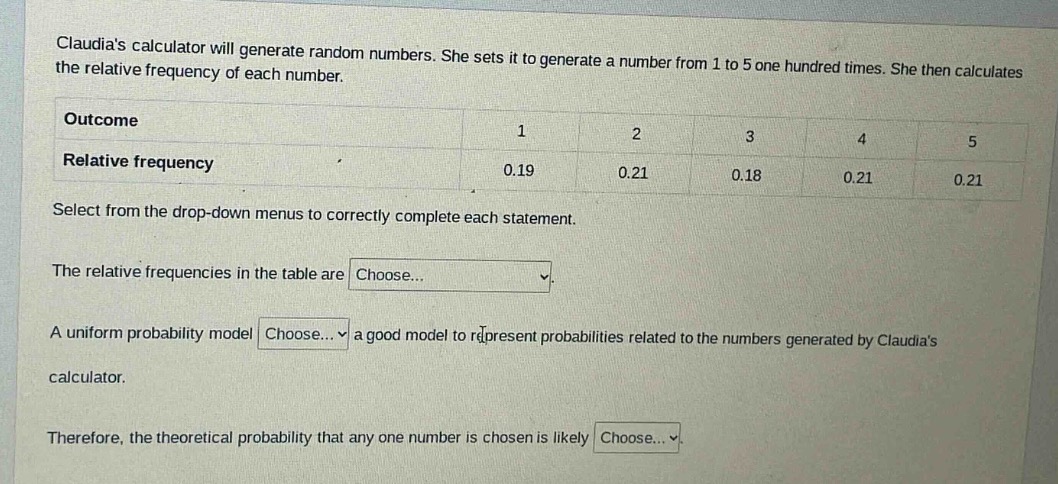
claudias calculator will generate random numbers. she sets it to generate a number from 1 to 5 one hundred times. she then calculates the relative frequency of each number.\noutcome 1 2 3 4 5\nrelative frequency 0.19 0.21 0.18 0.21 0.21\nselect from the drop - down menus to correctly complete each statement.\nthe relative frequencies in the table are choose...\na uniform probability model choose... a good model to represent probabilities related to the numbers generated by claudias calculator.\ntherefore, the theoretical probability that any one number is chosen is likely choose...
Answer
Explanation:
Step1: Recall properties of relative - frequencies
The sum of all relative frequencies in a probability distribution should be 1. Calculate the sum: $0.19 + 0.21+0.18 + 0.21+0.21=1$. Also, in a uniform probability model, all outcomes are equally likely. Here, the relative - frequencies are close to each other but not exactly the same.
Step2: Analyze uniform probability model
A uniform probability model assumes that all outcomes have the same probability. Since the relative frequencies are not exactly equal (although close), a uniform probability model is not a perfect but a reasonable model.
Step3: Determine theoretical probability
In a uniform distribution of 5 equally - likely outcomes (numbers 1 to 5), the theoretical probability of choosing any one number is $\frac{1}{5}=0.2$.
Answer:
The relative frequencies in the table are reasonable. A uniform probability model is a reasonable a good model to represent probabilities related to the numbers generated by Claudia's calculator. Therefore, the theoretical probability that any one number is chosen is likely 0.2.