the clients who get haircuts at camerons salon have a variety of hair colors. brown 7 black 7 blond 4 what…
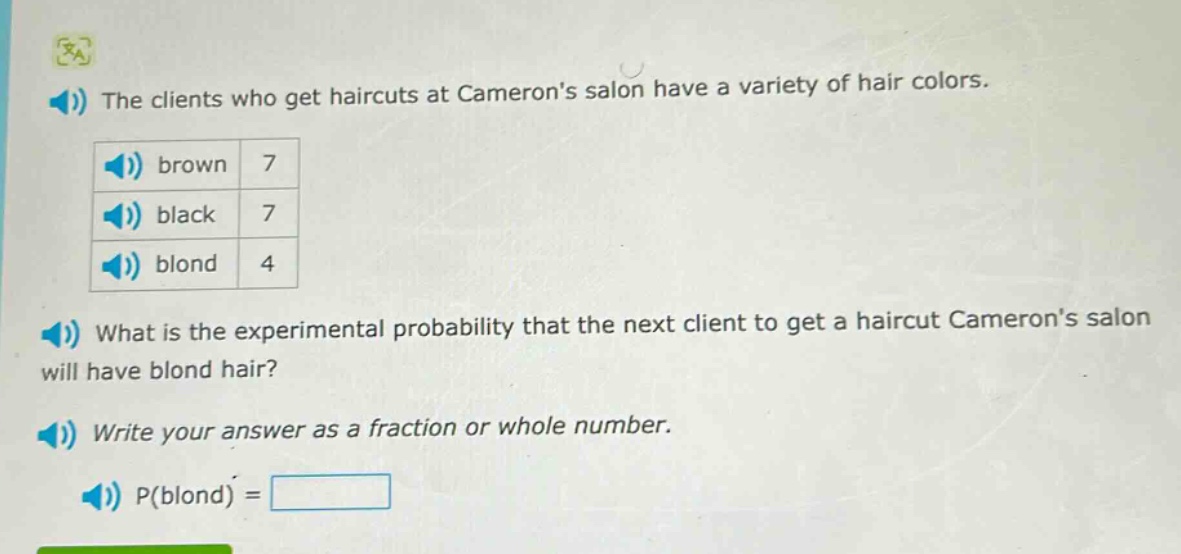
the clients who get haircuts at camerons salon have a variety of hair colors. brown 7 black 7 blond 4 what is the experimental probability that the next client to get a haircut camerons salon will have blond hair? write your answer as a fraction or whole number. p(blond) =
Answer
Explanation:
Step1: Calculate the total number of clients.
The total number of clients is the sum of clients with each hair color. $$ \text{Total clients} = 7 (\text{brown}) + 7 (\text{black}) + 4 (\text{blond}) = 18 $$
Step2: Identify the number of clients with blond hair.
From the table, the number of clients with blond hair is 4. $$ \text{Number of blond clients} = 4 $$
Step3: Calculate the experimental probability.
The experimental probability of an event is the ratio of the number of times the event occurred to the total number of trials. $$ P(\text{blond}) = \frac{\text{Number of blond clients}}{\text{Total clients}} $$ $$ P(\text{blond}) = \frac{4}{18} $$
Step4: Simplify the fraction.
Divide both the numerator and the denominator by their greatest common divisor, which is 2. $$ P(\text{blond}) = \frac{4 \div 2}{18 \div 2} = \frac{2}{9} $$
Answer:
$$ P(\text{blond}) = \frac{2}{9} $$