a coin is flipped, then a number cube is rolled. the tree diagram shows the possible outcomes. what is…
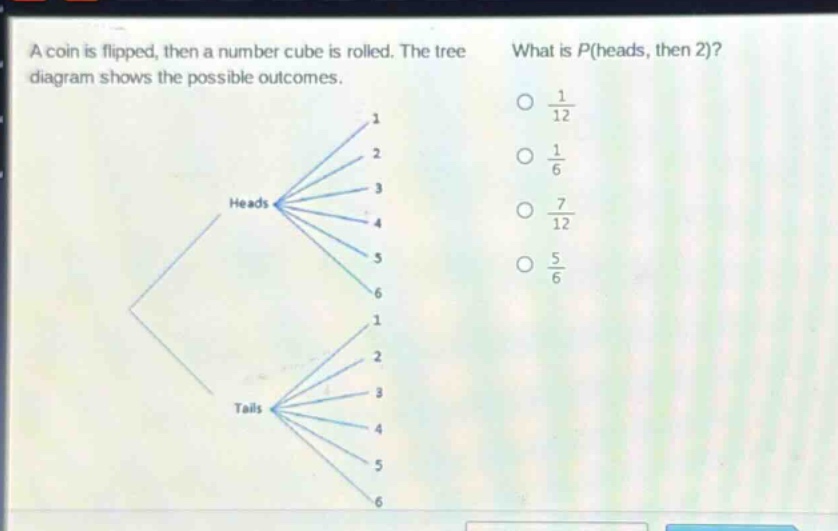
a coin is flipped, then a number cube is rolled. the tree diagram shows the possible outcomes. what is p(heads, then 2)?
Answer
Explanation:
Step1: Find the probability of flipping heads.
A standard coin has two sides, Heads and Tails. Assuming the coin is fair, the probability of flipping heads is: $$P(\text{Heads}) = \frac{1}{2}$$
Step2: Find the probability of rolling a 2.
A standard number cube (die) has six faces numbered 1 to 6. Assuming the cube is fair, the probability of rolling a 2 is: $$P(2) = \frac{1}{6}$$
Step3: Calculate the probability of both independent events.
Since the coin flip and the number cube roll are independent events, the probability of both occurring in sequence is the product of their individual probabilities: $$P(\text{Heads, then } 2) = P(\text{Heads}) \times P(2)$$ $$P(\text{Heads, then } 2) = \frac{1}{2} \times \frac{1}{6}$$ $$P(\text{Heads, then } 2) = \frac{1}{12}$$
Answer:
$\frac{1}{12}$