a coin is flipped, then a number cube is rolled. the tree diagram shows the possible outcomes. what is…
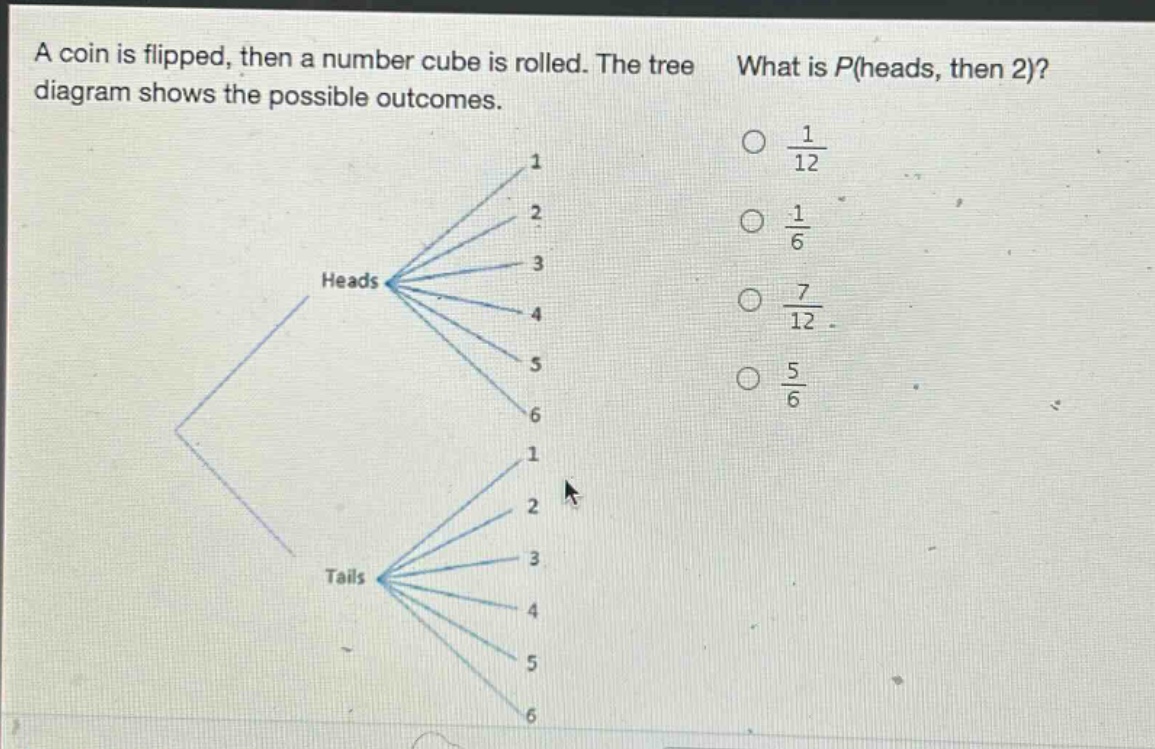
a coin is flipped, then a number cube is rolled. the tree diagram shows the possible outcomes. what is p(heads, then 2)? $\frac{1}{12}$ $\frac{1}{6}$ $\frac{7}{12}$ $\frac{5}{6}$
Answer
Explanation:
Step1: Find probability of getting heads
The probability of getting heads when flipping a fair coin is $P(\text{heads})=\frac{1}{2}$ since there are 2 possible outcomes (heads or tails) and 1 favorable outcome (heads).
Step2: Find probability of rolling a 2
The probability of rolling a 2 on a fair number - cube (with 6 sides numbered 1 - 6) is $P(2)=\frac{1}{6}$ since there are 6 possible outcomes and 1 favorable outcome (rolling a 2).
Step3: Use the multiplication rule for independent events
Since the coin - flip and the number - cube roll are independent events, the probability of both events occurring is the product of their individual probabilities. So $P(\text{heads, then }2)=P(\text{heads})\times P(2)$. Substitute the values: $P(\text{heads, then }2)=\frac{1}{2}\times\frac{1}{6}=\frac{1}{12}$.
Answer:
$\frac{1}{12}$