a coin and a six - sided die are tossed. event a: the coin lands on tails. event b: the die does not land on…
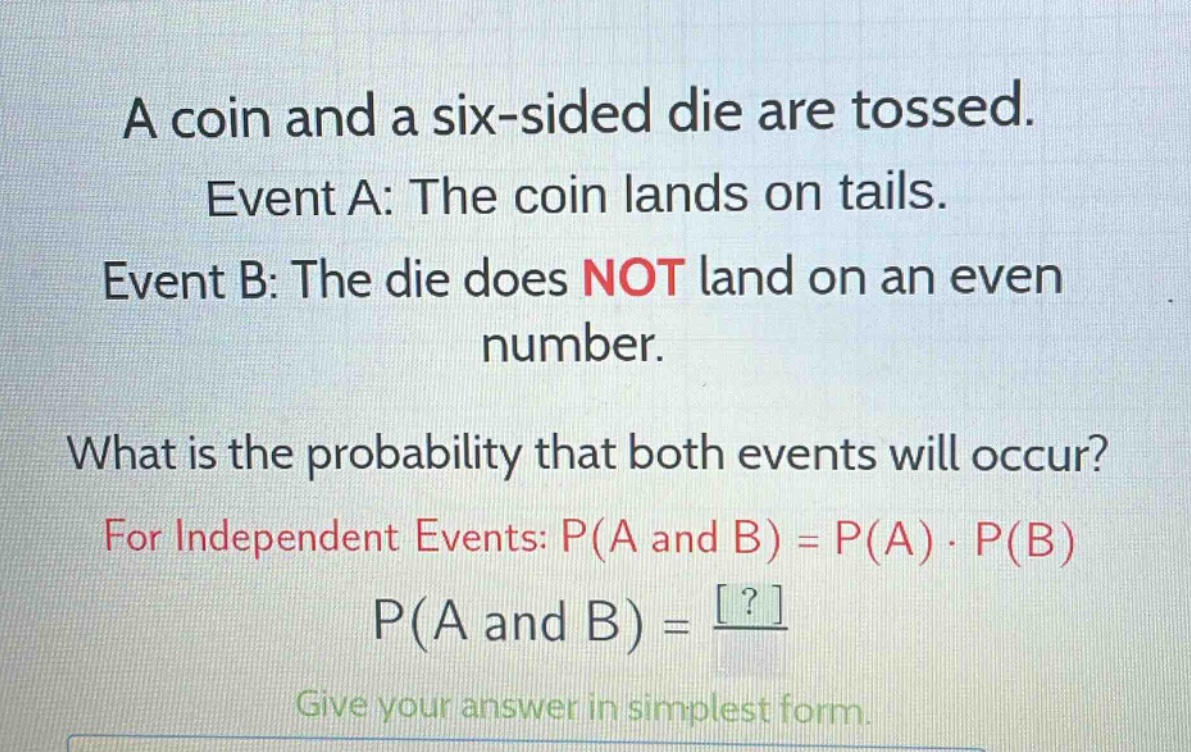
a coin and a six - sided die are tossed. event a: the coin lands on tails. event b: the die does not land on an even number. what is the probability that both events will occur? for independent events: p(a and b)=p(a)·p(b) p(a and b)=? give your answer in simplest form.
Answer
Explanation:
Step1: Calculate P(A)
A coin has 2 sides. The probability of getting tails (event A) is $P(A)=\frac{1}{2}$.
Step2: Calculate P(B)
A six - sided die has 6 numbers: 1, 2, 3, 4, 5, 6. The odd numbers (not even) are 1, 3, 5. So $P(B)=\frac{3}{6}=\frac{1}{2}$.
Step3: Calculate P(A and B)
Since A and B are independent events, $P(A\text{ and }B)=P(A)\cdot P(B)$. Substitute $P(A)=\frac{1}{2}$ and $P(B)=\frac{1}{2}$ into the formula. So $P(A\text{ and }B)=\frac{1}{2}\times\frac{1}{2}=\frac{1}{4}$.
Answer:
$\frac{1}{4}$