a coin will be tossed twice, and each toss will be recorded as heads (h) or tails (t). give the sample space…
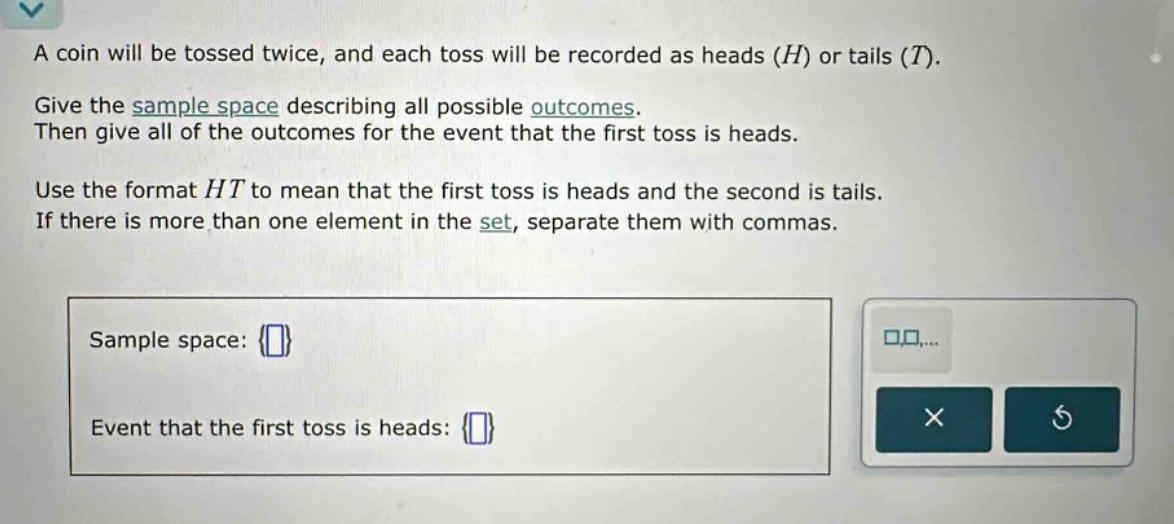
a coin will be tossed twice, and each toss will be recorded as heads (h) or tails (t). give the sample space describing all possible outcomes. then give all of the outcomes for the event that the first toss is heads. use the format ht to mean that the first toss is heads and the second is tails. if there is more than one element in the set, separate them with commas. sample space: {} event that the first toss is heads: {}
Answer
Explanation:
Step1: List all possible outcomes for two - coin tosses
For the first toss, there are 2 possibilities (heads or tails), and for each of these, the second toss also has 2 possibilities. So the sample space is all combinations. The sample space is ${HH, HT, TH, TT}$.
Step2: Identify outcomes with first - toss as heads
We look for elements in the sample space where the first letter is 'H'. The outcomes for the event that the first toss is heads are ${HH, HT}$.
Answer:
Sample space: $HH, HT, TH, TT$ Event that the first toss is heads: $HH, HT$