on a college entrance exam a total of 25 minutes is allotted for students to answer 20 math questions…
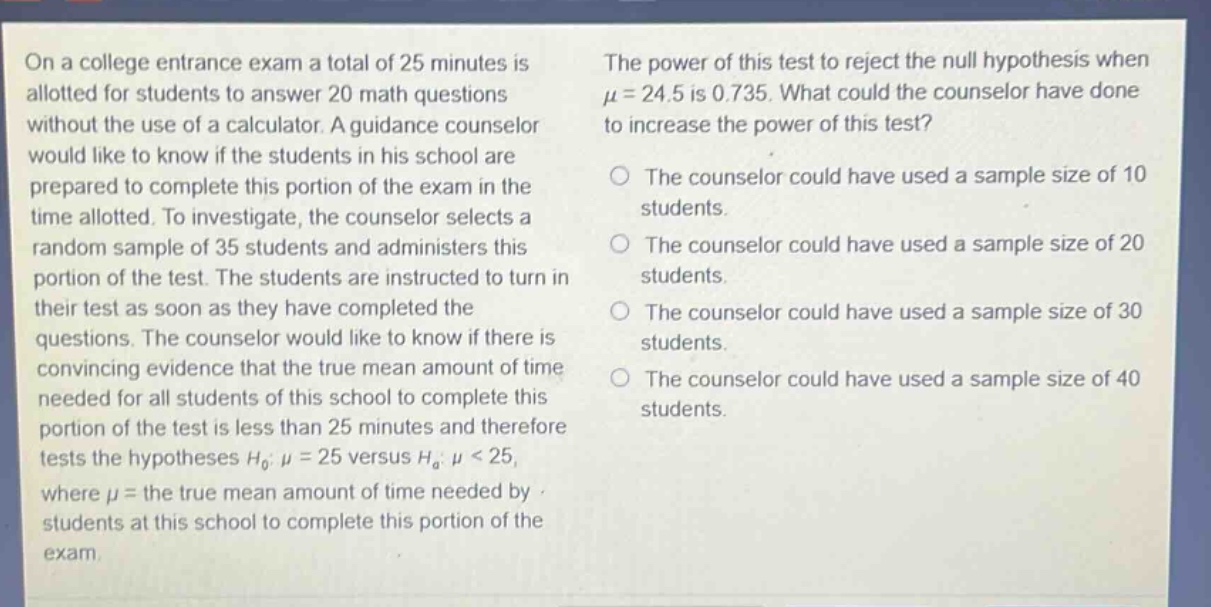
on a college entrance exam a total of 25 minutes is allotted for students to answer 20 math questions without the use of a calculator. a guidance counselor would like to know if the students in his school are prepared to complete this portion of the exam in the time allotted. to investigate, the counselor selects a random sample of 35 students and administers this portion of the test. the students are instructed to turn in their test as soon as they have completed the questions. the counselor would like to know if there is convincing evidence that the true mean amount of time needed for all students of this school to complete this portion of the test is less than 25 minutes and therefore tests the hypotheses $h_0: mu = 25$ versus $h_a: mu < 25$, where $mu$ = the true mean amount of time needed by students at this school to complete this portion of the exam. the power of this test to reject the null hypothesis when $mu = 24.5$ is 0.735. what could the counselor have done to increase the power of this test?\no the counselor could have used a sample size of 10 students.\no the counselor could have used a sample size of 20 students.\no the counselor could have used a sample size of 30 students.\no the counselor could have used a sample size of 40 students.
Answer
Explanation:
Step1: Recall power - sample size relationship
The power of a hypothesis test is positively related to the sample size. Larger sample sizes generally increase the power of a test.
Step2: Analyze given sample - size options
Among the options of sample sizes 10, 20, 30, and 40, the largest sample size is 40. A larger sample size gives more information and makes it more likely to reject the null hypothesis when it is false, thus increasing the power of the test.
Answer:
The counselor could have used a sample size of 40 students.