a company makes valves. based on a random sample, the company concludes that 7% ± 1.9% of the valves have…
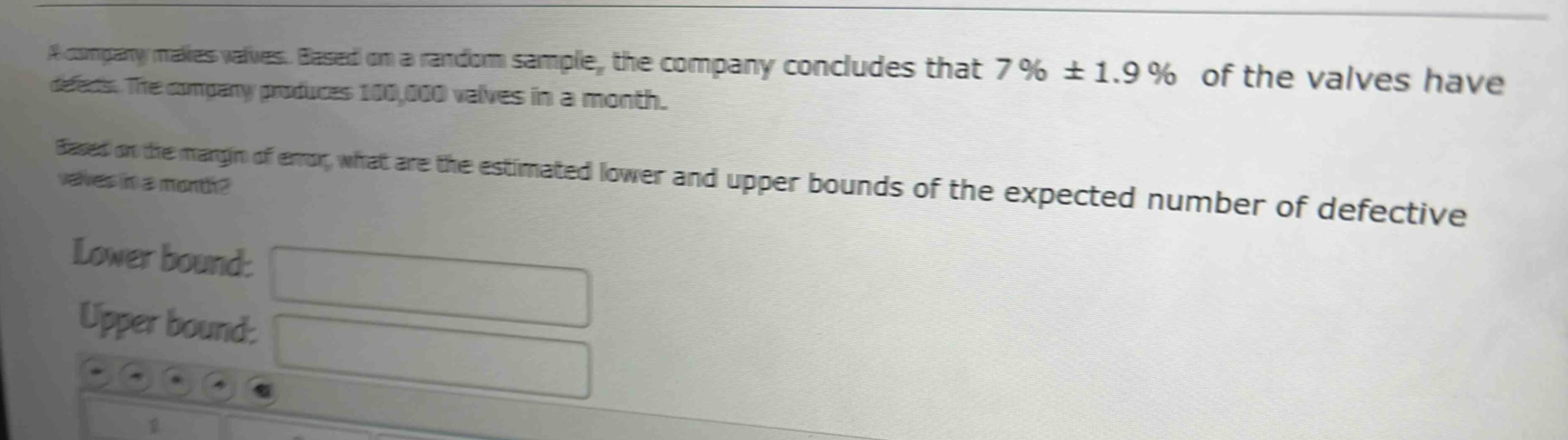
a company makes valves. based on a random sample, the company concludes that 7% ± 1.9% of the valves have defects. the company produces 100,000 valves in a month. based on the margin of error, what are the estimated lower and upper bounds of the expected number of defective valves in a month? lower bound: blank upper bound: blank
Answer
Explanation:
Step1: Calculate lower - bound percentage
Subtract margin of error from the percentage. $7%−1.9% = 5.1%$
Step2: Calculate lower - bound number of defective valves
Multiply the lower - bound percentage by the total number of valves. $100000\times0.051 = 5100$
Step3: Calculate upper - bound percentage
Add margin of error to the percentage. $7% + 1.9%=8.9%$
Step4: Calculate upper - bound number of defective valves
Multiply the upper - bound percentage by the total number of valves. $100000\times0.089 = 8900$
Answer:
Lower bound: 5100 Upper bound: 8900