complete the frequency table for the following set of data. you may optionally click a number to shade it…
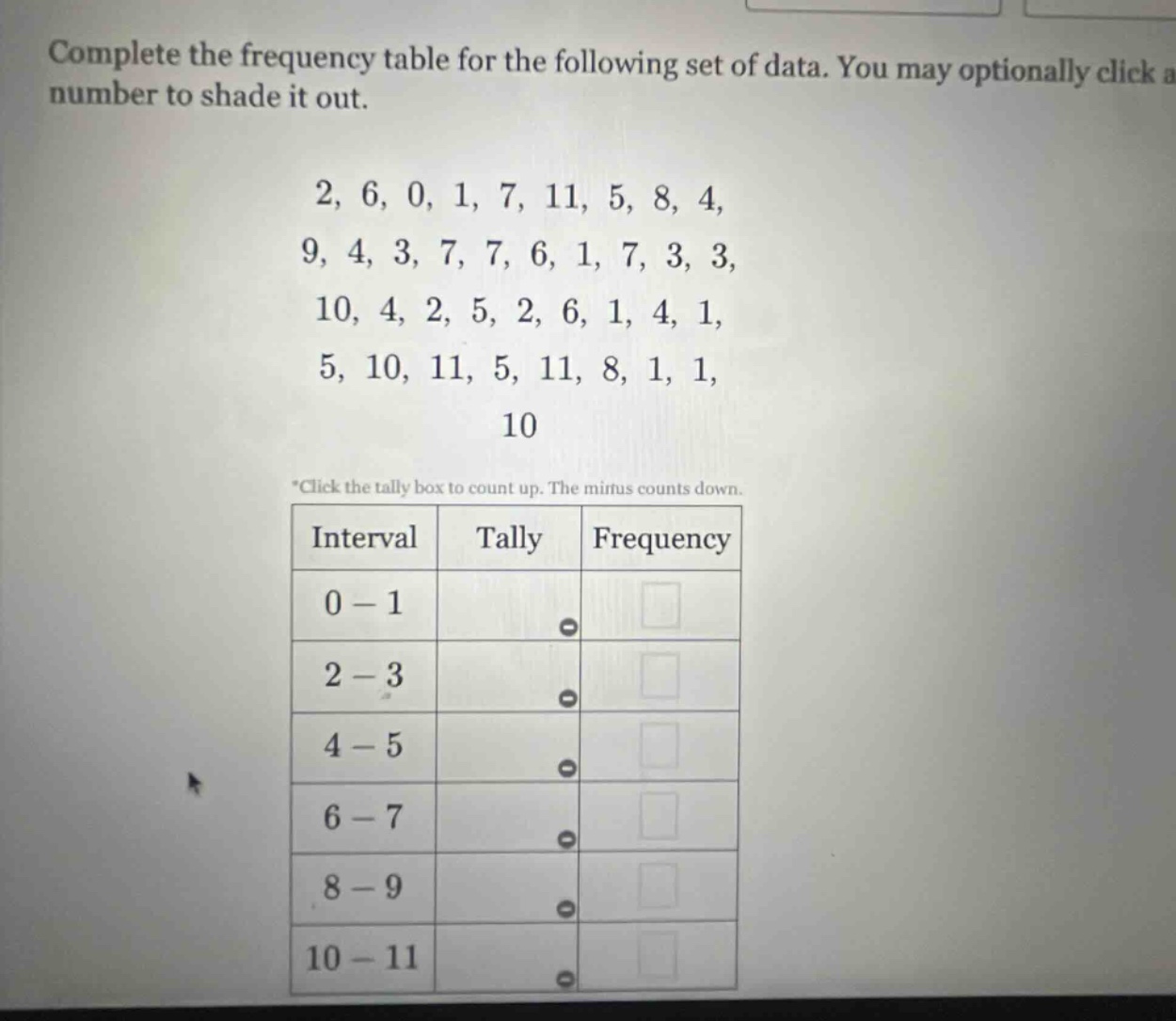
complete the frequency table for the following set of data. you may optionally click a number to shade it out.\n2, 6, 0, 1, 7, 11, 5, 8, 4,\n9, 4, 3, 7, 7, 6, 1, 7, 3, 3,\n10, 4, 2, 5, 2, 6, 1, 4, 1,\n5, 10, 11, 5, 11, 8, 1, 1,\n10\n*click the tally box to count up. the minus counts down.\n|interval|tally|frequency|\n|----|----|----|\n|0 - 1| | |\n|2 - 3| | |\n|4 - 5| | |\n|6 - 7| | |\n|8 - 9| | |\n|10 - 11| | |
Answer
Explanation:
Step1: Count numbers in 0 - 1
Count the number of 0s and 1s in the data set. There are 1 zero and 9 ones, so the frequency is 1 + 9=10.
Step2: Count numbers in 2 - 3
Count the number of 2s and 3s. There are 3 twos and 4 threes, so the frequency is 3 + 4 = 7.
Step3: Count numbers in 4 - 5
Count the number of 4s and 5s. There are 4 fours and 4 fives, so the frequency is 4+4 = 8.
Step4: Count numbers in 6 - 7
Count the number of 6s and 7s. There are 3 sixes and 4 sevens, so the frequency is 3 + 4=7.
Step5: Count numbers in 8 - 9
Count the number of 8s and 9s. There are 2 eights and 1 nine, so the frequency is 2 + 1=3.
Step6: Count numbers in 10 - 11
Count the number of 10s and 11s. There are 3 tens and 4 elevens, so the frequency is 3+4 = 7.
Answer:
| Interval | Tally | Frequency |
|---|---|---|
| 0 - 1 | 10 | 10 |
| 2 - 3 | 7 | 7 |
| 4 - 5 | 8 | 8 |
| 6 - 7 | 7 | 7 |
| 8 - 9 | 3 | 3 |
| 10 - 11 | 7 | 7 |