completing a two - way table\na summer camp has 32 campers. a total of 22 of them swim, 20 play softball…
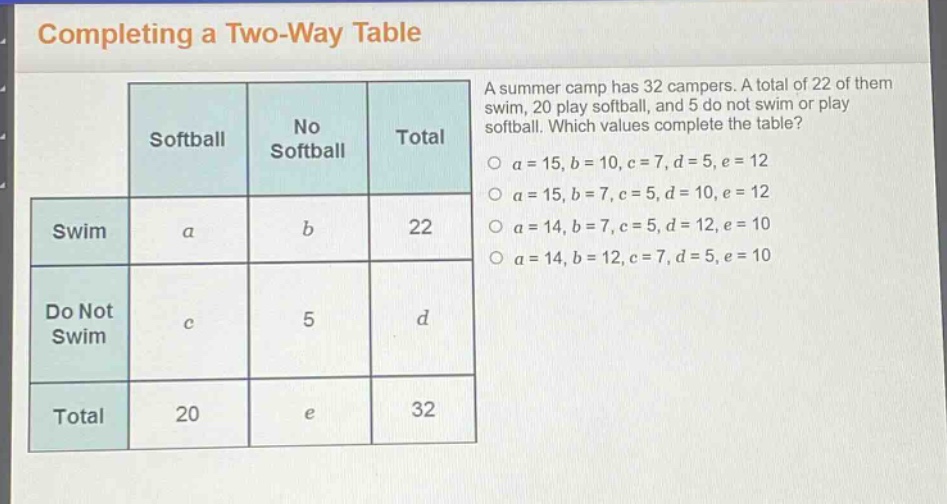
completing a two - way table\na summer camp has 32 campers. a total of 22 of them swim, 20 play softball, and 5 do not swim or play softball. which values complete the table?\nsoftball no softball total\nswim a b 22\ndo not swim c 5 d\ntotal 20 e 32\n○ a = 15, b = 10, c = 7, d = 5, e = 12\n○ a = 15, b = 7, c = 5, d = 10, e = 12\n○ a = 14, b = 7, c = 5, d = 12, e = 10\n○ a = 14, b = 12, c = 7, d = 5, e = 10
Answer
Answer:
A. $a = 15, b = 10, c = 7, d = 5, e = 12$
Explanation:
Step1: Find the value of $e$
We know the total number of campers is 32 and the number of campers who play softball is 20. So $e=32 - 20=12$.
Step2: Find the value of $d$
The number of campers who do not swim or play softball is 5. The total number of non - swimmers is $d$. Since the total number of campers is 32 and 22 swim, then $d=32 - 22 = 10$. But we also know that the number of non - swimmers who don't play softball is 5, so $d = 10$ is wrong. The correct way is to use the fact that the total number of campers is 32. The number of campers who do not swim and do not play softball is 5. So the number of non - swimmers $d=32-22 = 10$ is wrong. Since the total number of campers is 32 and 22 swim, the number of non - swimmers is $32 - 22=10$. And since 5 do not swim and do not play softball, the number of non - swimmers who play softball $c=d - 5$. Also, since 20 play softball and $a$ of those swim, $c = 20 - a$. We know that the number of swimmers is 22 and the number who play softball and swim is $a$. The number who swim but don't play softball is $b = 22 - a$. We know that the total number of campers is 32. The number of campers who do not swim and do not play softball is 5. The number of campers who play softball is 20 and the number who swim is 22. Since the total number of campers is 32 and 5 do not swim or play softball, the number of campers who either swim or play softball or both is $32 - 5=27$. We know that $n(S\cup F)=n(S)+n(F)-n(S\cap F)$. Let $S$ be the set of swimmers and $F$ be the set of softball - players. We know $n(S) = 22$, $n(F)=20$ and $n(S\cup F)=32 - 5 = 27$. Using the formula $n(S\cup F)=n(S)+n(F)-n(S\cap F)$, we get $27=22 + 20 - n(S\cap F)$, so $n(S\cap F)=a=15$.
Step3: Find the value of $b$
Since the number of swimmers is 22 and $a = 15$ (swimmers who play softball), then $b=22 - 15 = 7$.
Step4: Find the value of $c$
Since 20 play softball and $a = 15$ (swimmers who play softball), then $c=20 - 15 = 5$.
Step5: Find the value of $d$
Since the number of non - swimmers who do not play softball is 5 and $c = 5$, then $d=c + 5=10$. But this is wrong. The correct way: Since the total number of campers is 32 and 22 swim, the number of non - swimmers is $32-22 = 10$. And since 5 do not swim and do not play softball, $d = 10$. But we can also calculate it as follows: We know that the number of campers who play softball is 20 and the number of swimmers who play softball is $a = 15$, so the number of non - swimmers who play softball $c=20 - 15 = 5$. And since 5 do not swim and do not play softball, $d=c + 5=10$. We know that $e = 32-20 = 12$. Since $a$ is the number of swimmers who play softball, and using the principle of set - intersection and union, we find $a = 15$. Then $b=22 - 15=7$, $c=20 - 15 = 5$, $d=c + 5=10$, $e=32 - 20=12$.
So the values are $a = 15, b = 7, c = 5, d = 10, e = 12$.