a computer is programmed to select two random numbers from 1 to 5. all possible outcomes are shown in the…
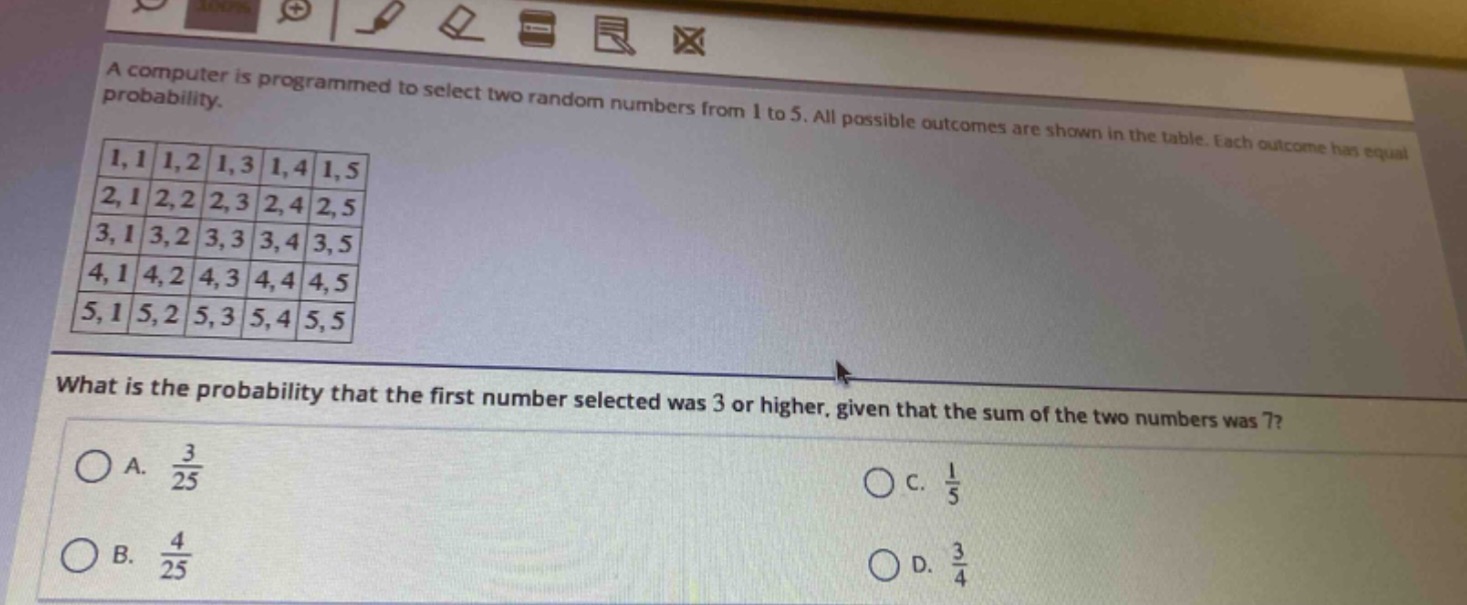
a computer is programmed to select two random numbers from 1 to 5. all possible outcomes are shown in the table. each outcome has equal probability.\n1,1 1,2 1,3 1,4 1,5\n2,1 2,2 2,3 2,4 2,5\n3,1 3,2 3,3 3,4 3,5\n4,1 4,2 4,3 4,4 4,5\n5,1 5,2 5,3 5,4 5,5\nwhat is the probability that the first number selected was 3 or higher, given that the sum of the two numbers was 7?\na. $\frac{3}{25}$\nc. $\frac{1}{5}$\nb. $\frac{4}{25}$\nd. $\frac{3}{4}$
Answer
Explanation:
Step1: Find pairs with sum 7
List pairs: (2, 5), (3, 4), (4, 3), (5, 2). There are 4 pairs with sum 7.
Step2: Count pairs with first - number 3 or higher among them
Pairs are (3, 4), (4, 3), (5, 2). There are 3 such pairs.
Step3: Calculate probability
Probability = $\frac{\text{Number of favorable outcomes}}{\text{Total number of outcomes in the condition}}=\frac{3}{4}$.
Answer:
D. $\frac{3}{4}$