a computer is programmed to select two random numbers from 1 to 5. all possible outcomes are shown in the…
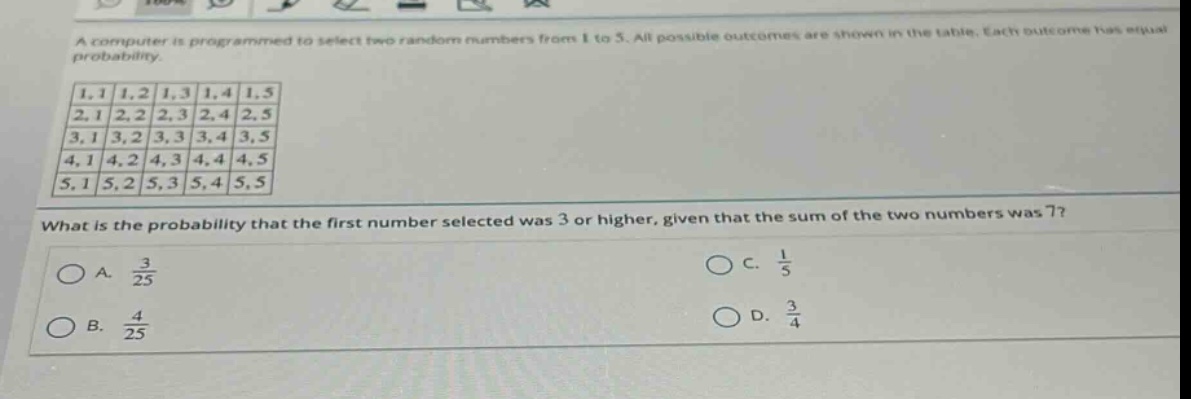
a computer is programmed to select two random numbers from 1 to 5. all possible outcomes are shown in the table. each outcome has equal probability.\nwhat is the probability that the first number selected was 3 or higher, given that the sum of the two numbers was 7?\na. $\frac{3}{25}$\nb. $\frac{4}{25}$\nc. $\frac{1}{5}$\nd. $\frac{3}{4}$
Answer
Explanation:
Step1: Find total outcomes with sum = 7
Let the two - number pairs be ((x,y)) where (x + y=7) and (1\leq x\leq5), (1\leq y\leq5). We solve the equation (y = 7 - x). When (x = 2), (y=5); when (x = 3), (y = 4); when (x=4), (y = 3); when (x = 5), (y=2). So (n(S)=4) (where (S) is the set of outcomes with sum equal to 7).
Step2: Find outcomes with sum = 7 and first number (\geq3)
From the pairs ((2,5),(3,4),(4,3),(5,2)), the pairs with (x\geq3) are ((3,4),(4,3),(5,2)). So (n(A)=3) (where (A) is the set of outcomes with sum equal to 7 and first number (\geq3)).
Step3: Use the formula for conditional probability
The formula for conditional probability is (P(A|B)=\frac{n(A\cap B)}{n(B)}). In the case of equally - likely outcomes, if (B) is the event that the sum of the two numbers is 7 and (A) is the event that the first number is 3 or higher, then (P(A|B)=\frac{\text{Number of outcomes in }A\cap B}{\text{Number of outcomes in }B}). Here, (P=\frac{3}{4}).
Answer:
D. (\frac{3}{4})