computing residuals from an equation and table\njohn estimates the value of his car over time. the equation…
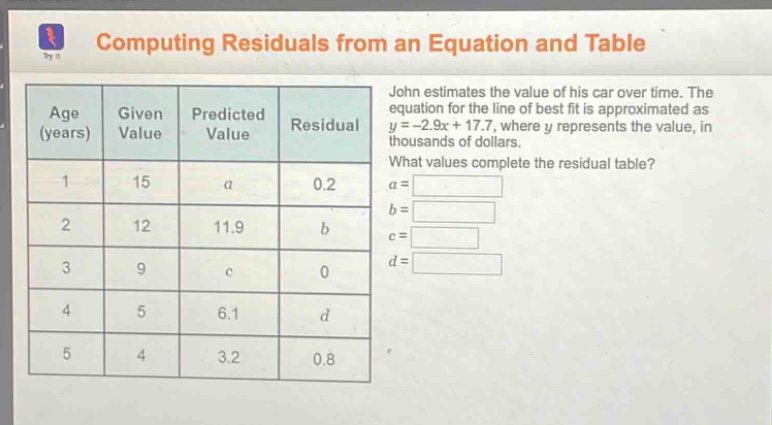
computing residuals from an equation and table\njohn estimates the value of his car over time. the equation for the line of best fit is approximated as y = -2.9x + 17.7, where y represents the value, in thousands of dollars.\nwhat values complete the residual table?\nage (years) given value predicted value residual\n1 15 a 0.2\n2 12 11.9 b\n3 9 c 0\n4 5 6.1 d\n5 4 3.2 0.8
Answer
Explanation:
Step1: Recall residual formula
Residual = Given value - Predicted value. So, Predicted value = Given value - Residual.
Step2: Calculate value of a
For age = 1, Given value = 15, Residual = 0.2. Then $a=15 - 0.2=14.8$.
Step3: Calculate value of b
For age = 2, Given value = 12, Predicted value = 11.9. Then $b=12 - 11.9 = 0.1$.
Step4: Calculate value of c
For age = 3, Given value = 9, Residual = 0. Then $c=9-0 = 9$.
Step5: Calculate value of d
For age = 4, Given value = 5, Predicted value = 6.1. Then $d=5 - 6.1=-1.1$.
Answer:
$a = 14.8$ $b = 0.1$ $c = 9$ $d=-1.1$