which could be a conditional relative frequency table? a b total c 0.25 0.25 0.50 d 0.25 0.25 0.50 total…
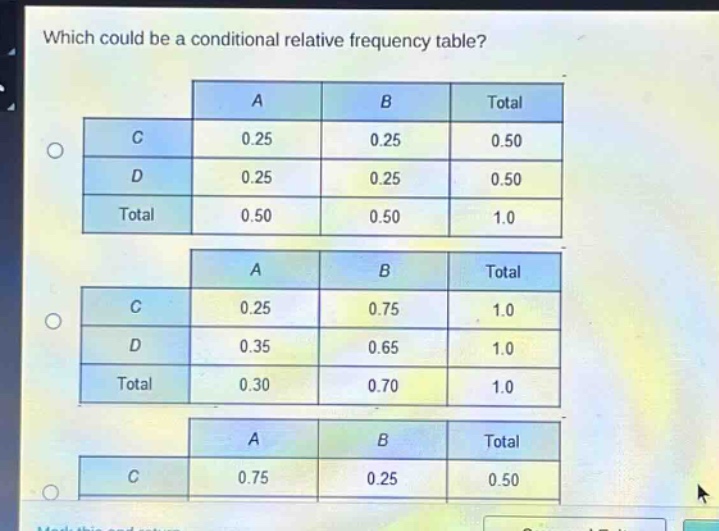
which could be a conditional relative frequency table? a b total c 0.25 0.25 0.50 d 0.25 0.25 0.50 total 0.50 0.50 1.0 a b total c 0.25 0.75 1.0 d 0.35 0.65 1.0 total 0.30 0.70 1.0 a b total c 0.75 0.25 0.50
Answer
Explanation:
Step1: Recall conditional relative - frequency property
In a conditional relative - frequency table, the sum of the relative frequencies for each row or each column (depending on the conditioning) is 1.
Step2: Analyze the first table
In the first table, for rows: (0.25 + 0.25=0.50\neq1) for both rows (C) and (D). So, it is not a conditional relative - frequency table.
Step3: Analyze the second table
For row (C): (0.25 + 0.75 = 1), for row (D): (0.35+0.65 = 1). The sums of the relative frequencies for each row are 1. This could be a conditional relative - frequency table.
Step4: Analyze the third table
For row (C): (0.75 + 0.25=1), but the sum of the column totals (0.50\neq1). Also, if we assume it is row - conditional, the row - sums are not all 1 in a proper way for a conditional relative - frequency table. So, it is not a conditional relative - frequency table.