consider the dataset from the following where $y_i$ is the qualitative response for observation $i$ and…
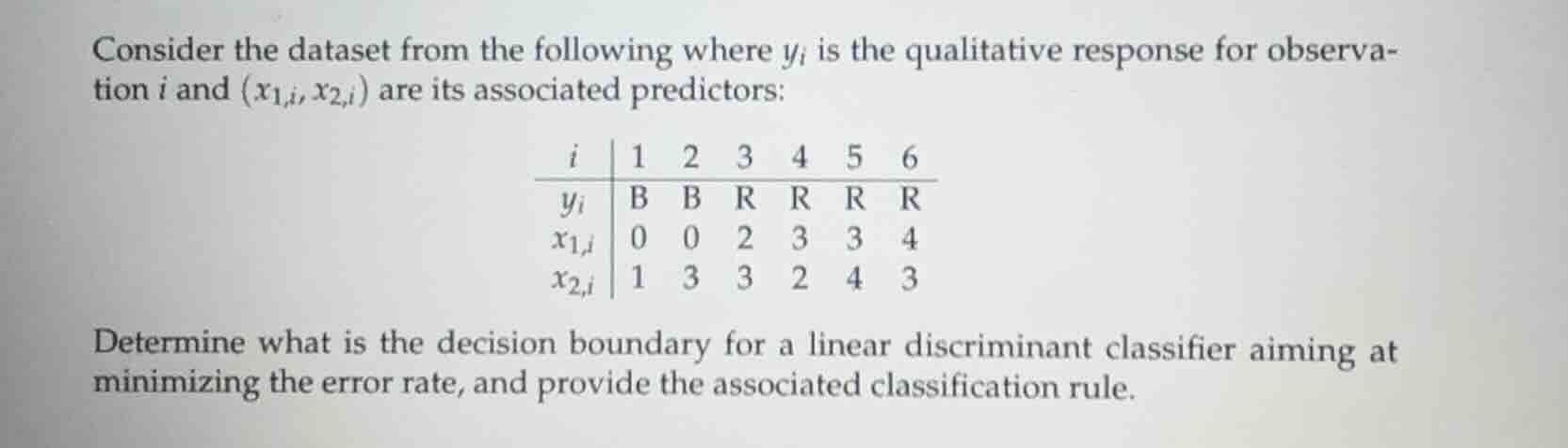
consider the dataset from the following where $y_i$ is the qualitative response for observation $i$ and $(x_{1,i}, x_{2,i})$ are its associated predictors:\n\n$$\\begin{array}{c|cccccc}\ni & 1 & 2 & 3 & 4 & 5 & 6 \\\\\n\\hline y_i & \\mathrm{b} & \\mathrm{b} & \\mathrm{r} & \\mathrm{r} & \\mathrm{r} & \\mathrm{r} \\\\\nx_{1,i} & 0 & 0 & 2 & 3 & 3 & 4 \\\\\nx_{2,i} & 1 & 3 & 3 & 2 & 4 & 3\n\\end{array}$$\n\ndetermine what is the decision boundary for a linear discriminant classifier aiming at minimizing the error rate, and provide the associated classification rule.
Answer
Explanation:
Step1: Calculate class means
For class B: $\mu_B = \frac{1}{2} \begin{pmatrix} 0+0 \ 1+3 \end{pmatrix} = \begin{pmatrix} 0 \ 2 \end{pmatrix}$. For class R: $\mu_R = \frac{1}{4} \begin{pmatrix} 2+3+3+4 \ 3+2+4+3 \end{pmatrix} = \begin{pmatrix} 3 \ 3 \end{pmatrix}$.
Step2: Calculate pooled covariance matrix
The within-class scatter matrices are $S_B = \begin{pmatrix} 0 & 0 \ 0 & 2 \end{pmatrix}$ and $S_R = \begin{pmatrix} 2 & 0 \ 0 & 2 \end{pmatrix}$. The pooled covariance is $\hat{\Sigma} = \frac{1}{n-K}(S_B + S_R) = \frac{1}{4} \begin{pmatrix} 2 & 0 \ 0 & 4 \end{pmatrix} = \begin{pmatrix} 0.5 & 0 \ 0 & 1 \end{pmatrix}$.
Step3: Find inverse of covariance
$$\hat{\Sigma}^{-1} = \begin{pmatrix} 2 & 0 \ 0 & 1 \end{pmatrix}$$
Step4: Determine decision boundary equation
The boundary is $x^T \hat{\Sigma}^{-1}(\mu_R - \mu_B) - \frac{1}{2}(\mu_R + \mu_B)^T \hat{\Sigma}^{-1}(\mu_R - \mu_B) + \ln(\frac{\pi_R}{\pi_B}) = 0$. $\mu_R - \mu_B = \begin{pmatrix} 3 \ 1 \end{pmatrix}$, $\pi_R = \frac{4}{6}$, $\pi_B = \frac{2}{6}$. $x^T \begin{pmatrix} 6 \ 1 \end{pmatrix} - \frac{1}{2} \begin{pmatrix} 3 \ 5 \end{pmatrix}^T \begin{pmatrix} 6 \ 1 \end{pmatrix} + \ln(2) = 0$. $6x_1 + x_2 - 11.5 + 0.693 = 0 \Rightarrow 6x_1 + x_2 - 10.807 = 0$.
Answer:
The decision boundary is $6x_1 + x_2 - 10.807 = 0$. The classification rule is: Classify as R if $6x_1 + x_2 > 10.807$, otherwise classify as B.