consider the following events:\na. the burrito is a chicken burrito.\nb. the burrito is a carne asada…
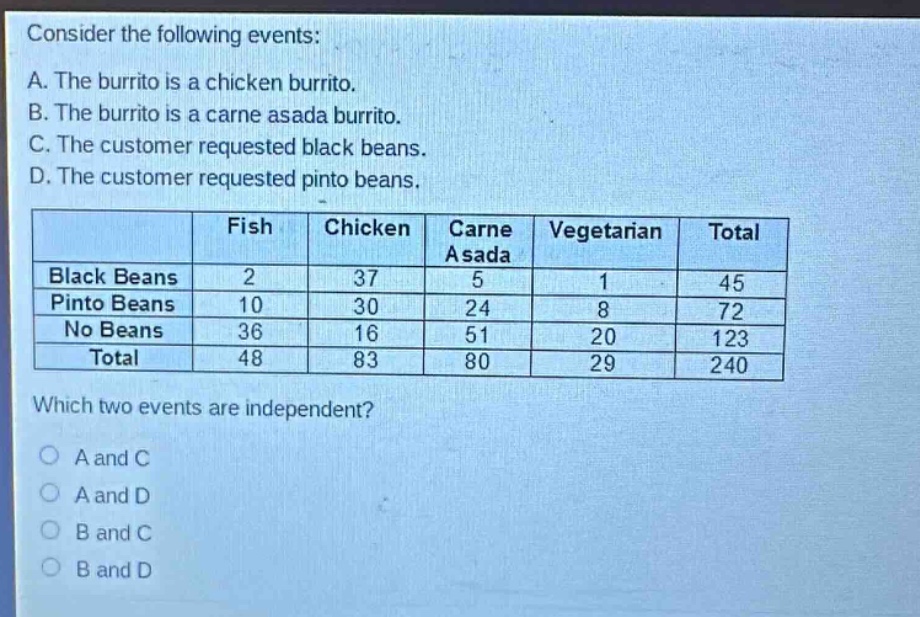
consider the following events:\na. the burrito is a chicken burrito.\nb. the burrito is a carne asada burrito.\nc. the customer requested black beans.\nd. the customer requested pinto beans.\n\n| | fish | chicken | carne asada | vegetarian | total |\n|--|--|--|--|--|--|\n| black beans | 2 | 37 | 5 | 1 | 45 |\n| pinto beans | 10 | 30 | 24 | 8 | 72 |\n| no beans | 36 | 16 | 51 | 20 | 123 |\n| total | 48 | 83 | 80 | 29 | 240 |\n\nwhich two events are independent?\na and c\na and d\nb and c\nb and d
Answer
Explanation:
Step1: Recall independence formula
Two events (E) and (F) are independent if (P(E\cap F)=P(E)\times P(F)).
Step2: Calculate (P(A))
(P(A)=\frac{83}{240}) (number of chicken burritos over total number of burritos).
Step3: Calculate (P(C))
(P(C)=\frac{45}{240}) (number of black - bean requests over total number of burritos).
Step4: Calculate (P(A\cap C))
(P(A\cap C)=\frac{37}{240}) (number of chicken burritos with black - bean requests over total number of burritos).
Step5: Calculate (P(A)\times P(C))
(P(A)\times P(C)=\frac{83}{240}\times\frac{45}{240}=\frac{83\times45}{240\times240}=\frac{3735}{57600}\neq\frac{37}{240}), so (A) and (C) are not independent.
Step6: Calculate (P(D))
(P(D)=\frac{72}{240}) (number of pinto - bean requests over total number of burritos).
Step7: Calculate (P(A\cap D))
(P(A\cap D)=\frac{30}{240}) (number of chicken burritos with pinto - bean requests over total number of burritos).
Step8: Calculate (P(A)\times P(D))
(P(A)\times P(D)=\frac{83}{240}\times\frac{72}{240}=\frac{83\times72}{240\times240}=\frac{5976}{57600}\neq\frac{30}{240}), so (A) and (D) are not independent.
Step9: Calculate (P(B))
(P(B)=\frac{80}{240}) (number of carne asada burritos over total number of burritos).
Step10: Calculate (P(B\cap C))
(P(B\cap C)=\frac{5}{240}) (number of carne asada burritos with black - bean requests over total number of burritos).
Step11: Calculate (P(B)\times P(C))
(P(B)\times P(C)=\frac{80}{240}\times\frac{45}{240}=\frac{80\times45}{240\times240}=\frac{3600}{57600}=\frac{5}{80}=\frac{5}{240}), so (B) and (C) are independent.
Step12: Calculate (P(B\cap D))
(P(B\cap D)=\frac{24}{240}) (number of carne asada burritos with pinto - bean requests over total number of burritos).
Step13: Calculate (P(B)\times P(D))
(P(B)\times P(D)=\frac{80}{240}\times\frac{72}{240}=\frac{80\times72}{240\times240}=\frac{5760}{57600}\neq\frac{24}{240}), so (B) and (D) are not independent.
Answer:
B and C