a consumer agency wants to determine which of two laundry detergents, a or b, cleans better. fifty pieces of…
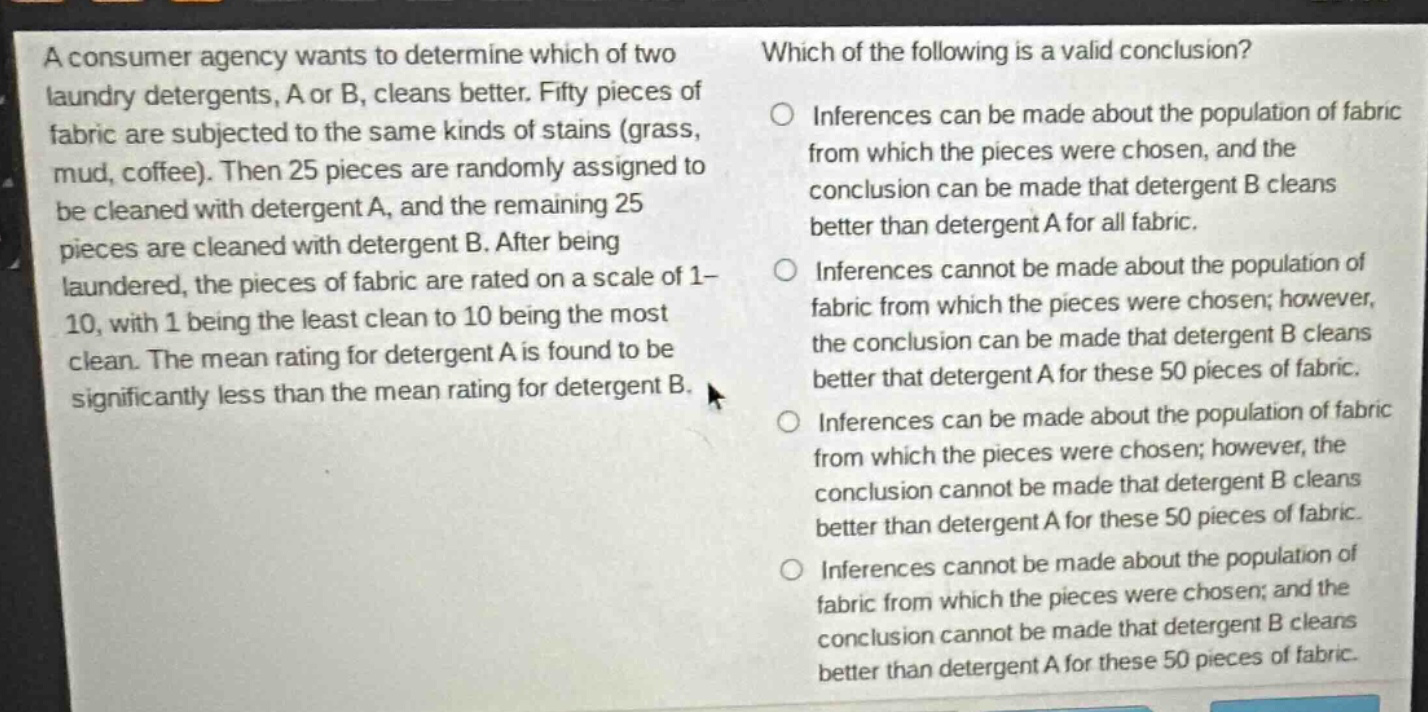
a consumer agency wants to determine which of two laundry detergents, a or b, cleans better. fifty pieces of fabric are subjected to the same kinds of stains (grass, mud, coffee). then 25 pieces are randomly assigned to be cleaned with detergent a, and the remaining 25 pieces are cleaned with detergent b. after being laundered, the pieces of fabric are rated on a scale of 1 - 10, with 1 being the least clean to 10 being the most clean. the mean rating for detergent a is found to be significantly less than the mean rating for detergent b. which of the following is a valid conclusion? inferences can be made about the population of fabric from which the pieces were chosen, and the conclusion can be made that detergent b cleans better than detergent a for all fabric. inferences cannot be made about the population of fabric from which the pieces were chosen; however, the conclusion can be made that detergent b cleans better that detergent a for these 50 pieces of fabric. inferences can be made about the population of fabric from which the pieces were chosen; however, the conclusion cannot be made that detergent b cleans better than detergent a for these 50 pieces of fabric. inferences cannot be made about the population of fabric from which the pieces were chosen; and the conclusion cannot be made that detergent b cleans better than detergent a for these 50 pieces of fabric.
Answer
Brief Explanations:
The 50 - piece fabric sample is a subset of a larger fabric population. Random assignment within the sample allows inferences about the population from which the sample was drawn. Since the mean rating of detergent B is significantly higher for the 50 - piece sample, we can say that for these 50 pieces, B cleans better. But we cannot generalize to all fabric types without further testing.
Answer:
Inferences can be made about the population of fabric from which the pieces were chosen; however, the conclusion can be made that detergent B cleans better than detergent A for these 50 pieces of fabric.