a contractor records the areas, in square feet, of a small sample of houses in a neighborhood to determine…
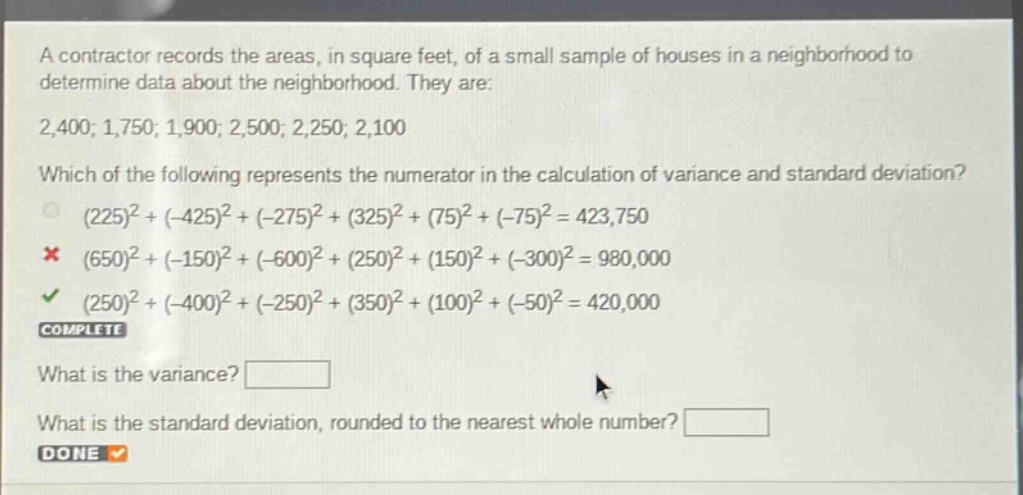
a contractor records the areas, in square feet, of a small sample of houses in a neighborhood to determine data about the neighborhood. they are: 2,400; 1,750; 1,900; 2,500; 2,250; 2,100 which of the following represents the numerator in the calculation of variance and standard deviation? (225)^2+(-425)^2+(-275)^2+(325)^2+(75)^2+(-75)^2 = 423,750 (650)^2+(-150)^2+(-600)^2+(250)^2+(150)^2+(-300)^2 = 980,000 (250)^2+(-400)^2+(-250)^2+(350)^2+(100)^2+(-50)^2 = 420,000 complete what is the variance? what is the standard deviation, rounded to the nearest whole number? done
Answer
Answer:
- Variance: 84000
- Standard Deviation: 290
Explanation:
Step1: Recall variance formula
The formula for the variance $s^{2}$ of a sample is $s^{2}=\frac{\sum_{i = 1}^{n}(x_{i}-\bar{x})^{2}}{n - 1}$, where $\sum_{i = 1}^{n}(x_{i}-\bar{x})^{2}$ is the numerator we already found as 420000 and $n=6$ (the number of data - points).
Step2: Calculate variance
$s^{2}=\frac{420000}{6 - 1}=\frac{420000}{5}=84000$.
Step3: Recall standard - deviation formula
The standard deviation $s$ of a sample is $s=\sqrt{s^{2}}$.
Step4: Calculate standard deviation
$s=\sqrt{84000}\approx289.83\approx290$ (rounded to the nearest whole number).