8. should cpr (cardio pulmonary resuscitation) be given to a person who partially breathing? 9. to learn…
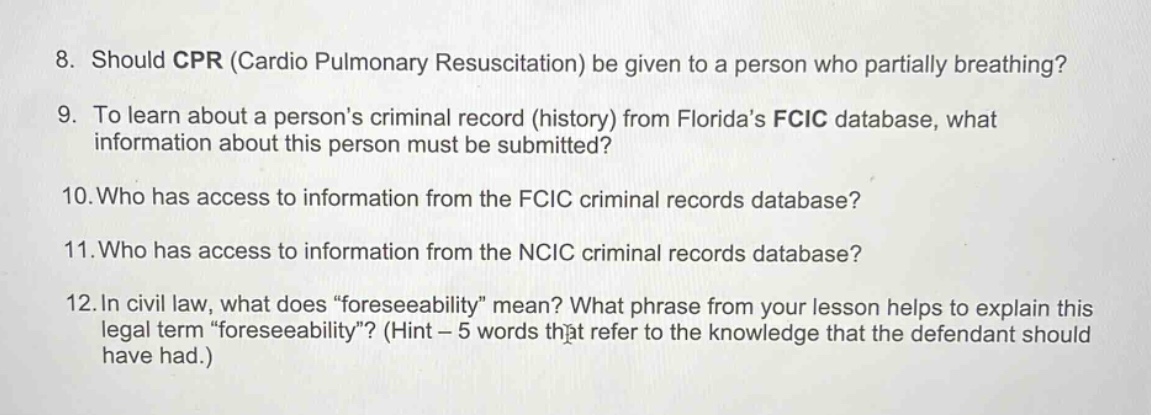
8. should cpr (cardio pulmonary resuscitation) be given to a person who partially breathing? 9. to learn about a persons criminal record (history) from floridas fcic database, what information about this person must be submitted? 10.who has access to information from the fcic criminal records database? 11.who has access to information from the ncic criminal records database? 12.in civil law, what does “foreseeability” mean? what phrase from your lesson helps to explain this legal term “foreseeability”? (hint – 5 words that refer to the knowledge that the defendant should have had.)
Answer
Brief Explanations:
- CPR is generally not given to a person who is partially breathing as it is meant for those in cardiac - arrest or not breathing adequately. Adequate spontaneous breathing is a sign that the body's oxygen - carbon dioxide exchange is somewhat intact.
- To access a person's criminal record from Florida's FCIC database, typically personal identifying information such as name, date of birth, and possibly social security number may be required to ensure accurate identification of the individual.
- Access to FCIC criminal records database is usually restricted to authorized law - enforcement personnel, certain government agencies, and in some cases, with proper legal authorization, other entities for legitimate purposes like background checks for employment in sensitive fields.
- The NCIC (National Crime Information Center) criminal records database access is mainly for law - enforcement agencies at local, state, and federal levels, as well as some authorized government entities for law - enforcement and public - safety related tasks.
- In civil law, "foreseeability" means the knowledge that a reasonable person (defendant) should have had that their actions or inactions could cause harm. The phrase "knowledge of the defendant" helps explain it.
Answer:
- No
- Name, date of birth, possibly social security number
- Authorized law - enforcement personnel, certain government agencies, etc.
- Law - enforcement agencies and some authorized government entities
- The knowledge a reasonable person should have that actions could cause harm; knowledge of the defendant