1. create a ranking system that weights gold medals as more significant than silver medals and silver medals…
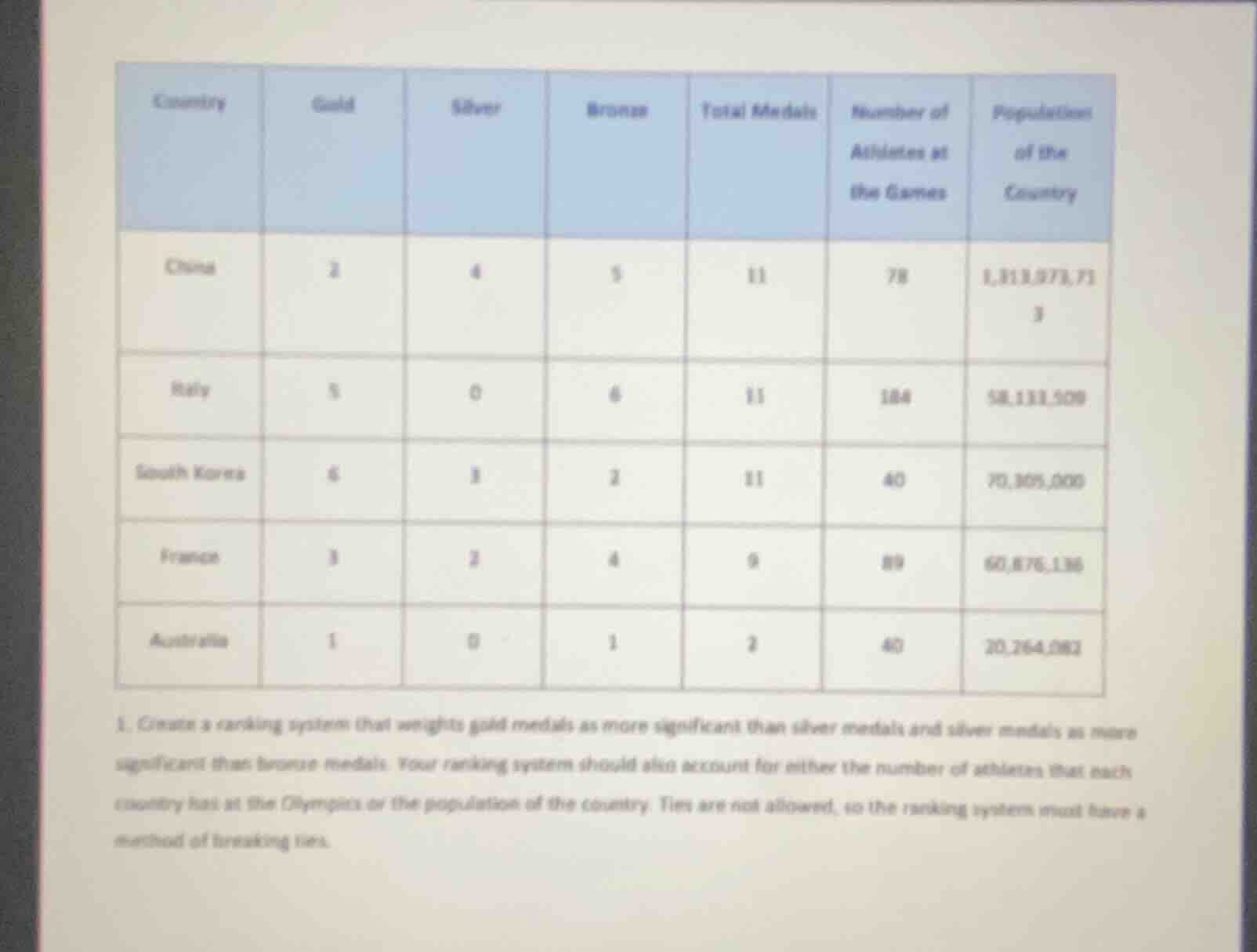
1. create a ranking system that weights gold medals as more significant than silver medals and silver medals as more significant than bronze medals. your ranking system should also account for either the number of athletes that each country has at the olympics or the population of the country. ties are not allowed, so the ranking system must have a method of breaking ties.
Answer
Explanation:
Step1: Define a weighted medal score
Assign weights: Gold ($G$) = 100, Silver ($S$) = 10, Bronze ($B$) = 1. $$Score_{medals} = 100G + 10S + B$$
Step2: Incorporate efficiency by athletes
Divide the medal score by the number of athletes ($A$). $$Final Score = \frac{100G + 10S + B}{A}$$
Step3: Calculate scores for each country
China: $\frac{245}{78} \approx 3.141$; Italy: $\frac{506}{184} \approx 2.750$; South Korea: $\frac{632}{40} = 15.800$; France: $\frac{324}{89} \approx 3.640$; Australia: $\frac{101}{40} = 2.525$.
Step4: Rank countries by final score
Order from highest to lowest score to determine ranking.
Answer:
- South Korea (15.800)
- France (3.640)
- China (3.141)
- Italy (2.750)
- Australia (2.525)