creating a conditional relative frequency table\na census was conducted that determined the land area and…
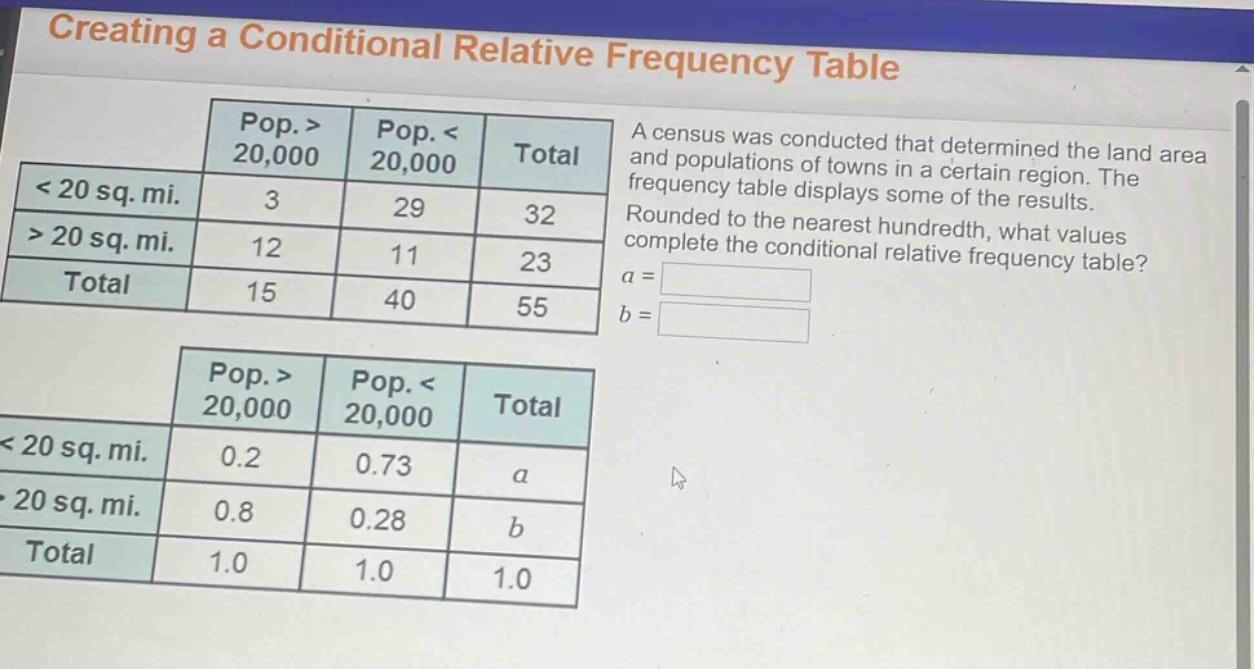
creating a conditional relative frequency table\na census was conducted that determined the land area and populations of towns in a certain region. the frequency table displays some of the results. rounded to the nearest hundredth, what values complete the conditional relative frequency table?\npop. > 20,000 pop. < 20,000 total\n< 20 sq. mi. 3 29 32\n> 20 sq. mi. 12 11 23\ntotal 15 40 55\npop. > 20,000 pop. < 20,000 total\n< 20 sq. mi. 0.2 0.73 a\n> 20 sq. mi. 0.8 0.28 b\ntotal 1.0 1.0 1.0
Answer
Answer:
$a = 0.93$ $b = 1.08$
Explanation:
Step1: Calculate $a$
In the row for area < 20 sq. mi., the sum of the conditional - relative frequencies gives $a$. So $a=0.2 + 0.73=0.93$.
Step2: Calculate $b$
In the row for area > 20 sq. mi., the sum of the conditional - relative frequencies gives $b$. So $b = 0.8+0.28 = 1.08$.