data communication ecom4411 - midterm - timeframe: 18 - 05 - 2025 to 23 - 05 - 2025\nq1 - 2. what are the…
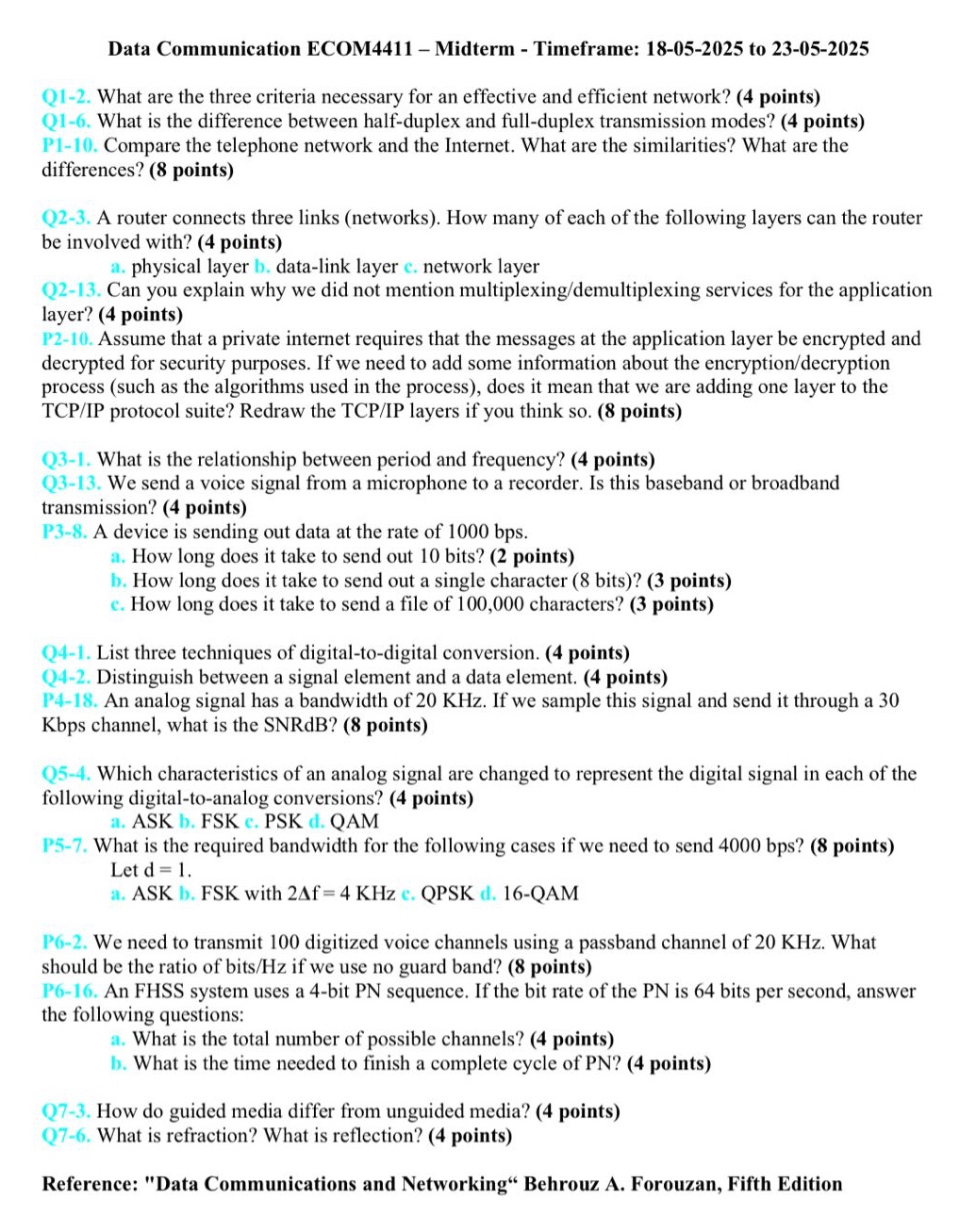
data communication ecom4411 - midterm - timeframe: 18 - 05 - 2025 to 23 - 05 - 2025\nq1 - 2. what are the three criteria necessary for an effective and efficient network? (4 points)\nq1 - 6. what is the difference between half - duplex and full - duplex transmission modes? (4 points)\np1 - 10. compare the telephone network and the internet. what are the similarities? what are the differences? (8 points)\nq2 - 3. a router connects three links (networks). how many of each of the following layers can the router be involved with? (4 points)\na. physical layer b. data - link layer c. network layer\nq2 - 13. can you explain why we did not mention multiplexing/demultiplexing services for the application layer? (4 points)\np2 - 10. assume that a private internet requires that the messages at the application layer be encrypted and decrypted for security purposes. if we need to add some information about the encryption/decryption process (such as the algorithms used in the process), does it mean that we are adding one layer to the tcp/ip protocol suite? redraw the tcp/ip layers if you think so. (8 points)\nq3 - 1. what is the relationship between period and frequency? (4 points)\nq3 - 13. we send a voice signal from a microphone to a recorder. is this baseband or broadband transmission? (4 points)\np3 - 8. a device is sending out data at the rate of 1000 bps.\na. how long does it take to send out 10 bits? (2 points)\nb. how long does it take to send out a single character (8 bits)? (3 points)\nc. how long does it take to send a file of 100,000 characters? (3 points)\nq4 - 1. list three techniques of digital - to - digital conversion. (4 points)\nq4 - 2. distinguish between a signal element and a data element. (4 points)\np4 - 18. an analog signal has a bandwidth of 20 khz. if we sample this signal and send it through a 30 kbps channel, what is the snrdb? (8 points)\nq5 - 4. which characteristics of an analog signal are changed to represent the digital signal in each of the following digital - to - analog conversions? (4 points)\na. ask b. fsk c. psk d. qam\np5 - 7. what is the required bandwidth for the following cases if we need to send 4000 bps? (8 points)\nlet d = 1.\na. ask b. fsk with 2δf = 4 khz c. qpsk d. 16 - qam\np6 - 2. we need to transmit 100 digitized voice channels using a passband channel of 20 khz. what should be the ratio of bits/hz if we use no guard band? (8 points)\np6 - 16. an fhss system uses a 4 - bit pn sequence. if the bit rate of the pn is 64 bits per second, answer the following questions:\na. what is the total number of possible channels? (4 points)\nb. what is the time needed to finish a complete cycle of pn? (4 points)\nq7 - 3. how do guided media differ from unguided media? (4 points)\nq7 - 6. what is refraction? what is reflection? (4 points)\nreference: \data communications and networking\ behrouz a. forouzan, fifth edition
Answer
Brief Explanations:
Q1 - 2: An effective and efficient network requires reliability (minimal errors), scalability (ability to grow), and security (protection of data). Q1 - 6: In half - duplex, communication is one - way at a time; in full - duplex, communication can occur in both directions simultaneously. P1 - 10: Similarities: Both are used for communication. Differences: Telephone network is circuit - switched mainly for voice, Internet is packet - switched for various data types. Q2 - 3: a. The router is involved with 3 physical layers (one for each link). b. 3 data - link layers. c. 1 network layer. Q2 - 13: The application layer deals with application - specific data, and multiplexing/demultiplexing is more relevant to lower layers that handle multiple data streams from different sources. P2 - 10: Adding encryption/decryption information does not add a new layer to the TCP/IP suite. The encryption/decryption can be part of the application layer functionality. Q3 - 1: The period (T) and frequency (f) are inversely related, $f=\frac{1}{T}$. Q3 - 13: Sending a voice signal from a microphone to a recorder is baseband transmission as the original signal is sent without modulation. P3 - 8: a. Time to send 10 bits at 1000 bps: $t=\frac{10}{1000}=0.01$ s. b. Time to send 8 bits (1 character) at 1000 bps: $t=\frac{8}{1000}=0.008$ s. c. A file of 100,000 characters has $100000\times8 = 800000$ bits. Time to send it at 1000 bps: $t=\frac{800000}{1000}=800$ s. Q4 - 1: Three digital - to - digital conversion techniques are NRZ (Non - Return to Zero), Manchester encoding, and Differential Manchester encoding. Q4 - 2: A signal element is a unit of the analog signal representing data, while a data element is a unit of data (e.g., a bit). P4 - 18: First, use the Nyquist formula $C = 2B\log_2(1 + SNR)$ to find SNR. Given $B = 20$ KHz and $C=30$ Kbps. Rearranging for SNR gives $SNR = 2^{\frac{C}{2B}}-1$. Then convert to dB: $SNR_{dB}=10\log_{10}(SNR)$. Q5 - 4: a. ASK changes the amplitude. b. FSK changes the frequency. c. PSK changes the phase. d. QAM changes both amplitude and phase. P5 - 7: For ASK, $B = R$ (where $R$ is the data rate), so $B = 4000$ Hz. For FSK with $\Delta f = 4$ KHz, $B=2\Delta f+R = 2\times4000 + 4000=12000$ Hz. For QPSK, $B=\frac{R}{2}=2000$ Hz. For 16 - QAM, $B=\frac{R}{4}=1000$ Hz. P6 - 2: We need to transmit 100 channels. If the bandwidth is 20 KHz, and assume each channel has a certain bit rate. The total bit rate for 100 channels is related to the bandwidth. The ratio of bits/Hz can be calculated based on the total bit rate and the bandwidth. P6 - 16: a. For a 4 - bit PN sequence, the total number of possible channels is $2^4 = 16$. b. The bit rate of PN is 64 bits per second. The time for a 4 - bit cycle is $t=\frac{4}{64}=0.0625$ s. Q7 - 3: Guided media have a physical path (e.g., cables), while unguided media use wireless means (e.g., radio waves). Q7 - 6: Refraction is the bending of a wave as it passes from one medium to another. Reflection is the bouncing back of a wave when it hits a boundary.
Answer:
Q1 - 2: Reliability, scalability, security. Q1 - 6: Half - duplex: one - way at a time; Full - duplex: both directions simultaneously. P1 - 10: Similarities: Used for communication. Differences: Telephone is circuit - switched for voice, Internet is packet - switched for various data. Q2 - 3: a. 3 physical layers. b. 3 data - link layers. c. 1 network layer. Q2 - 13: Multiplexing/demultiplexing more relevant to lower layers. P2 - 10: No new layer added. Encryption/decryption can be part of application layer. Q3 - 1: $f=\frac{1}{T}$. Q3 - 13: Baseband transmission. P3 - 8: a. 0.01 s. b. 0.008 s. c. 800 s. Q4 - 1: NRZ, Manchester encoding, Differential Manchester encoding. Q4 - 2: Signal element: unit of analog signal representing data; Data element: unit of data (e.g., bit). P4 - 18: Calculate using Nyquist formula and convert to dB. Q5 - 4: a. Amplitude. b. Frequency. c. Phase. d. Amplitude and phase. P5 - 7: a. 4000 Hz. b. 12000 Hz. c. 2000 Hz. d. 1000 Hz. P6 - 2: Calculate based on total bit rate and bandwidth. P6 - 16: a. 16. b. 0.0625 s. Q7 - 3: Guided media have physical path, unguided media are wireless. Q7 - 6: Refraction: wave bending; Reflection: wave bouncing back.