the data set below has a lower quartile of 13 and an upper quartile of 37.\n1, 12, 13, 15, 18, 20, 35, 37…
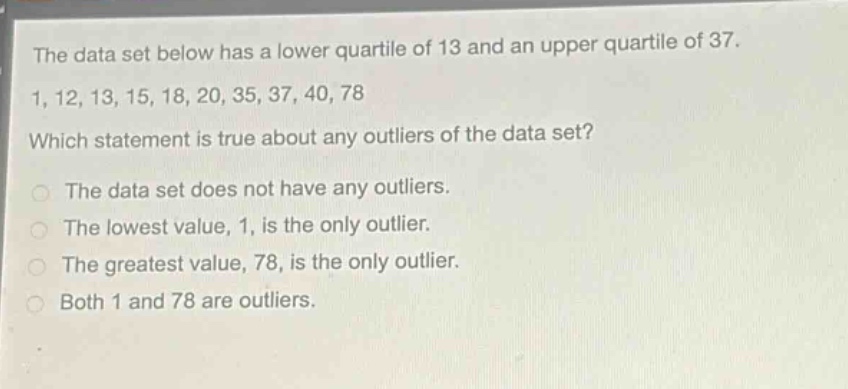
the data set below has a lower quartile of 13 and an upper quartile of 37.\n1, 12, 13, 15, 18, 20, 35, 37, 40, 78\nwhich statement is true about any outliers of the data set?\nthe data set does not have any outliers.\nthe lowest value, 1, is the only outlier.\nthe greatest value, 78, is the only outlier.\nboth 1 and 78 are outliers.
Answer
Explanation:
Step1: Calculate the inter - quartile range (IQR)
The inter - quartile range (IQR = Q_{3}-Q_{1}). Given (Q_{1} = 13) and (Q_{3}=37), so (IQR=37 - 13=24).
Step2: Calculate the lower and upper bounds for non - outliers
The lower bound for non - outliers is (Q_{1}-1.5\times IQR). Substitute (Q_{1}=13) and (IQR = 24) into the formula: (13-1.5\times24=13 - 36=-23). The upper bound for non - outliers is (Q_{3}+1.5\times IQR). Substitute (Q_{3}=37) and (IQR = 24) into the formula: (37+1.5\times24=37 + 36 = 73).
Step3: Check for outliers
Check each data point against the bounds. For the data point (x = 1), since (-23<1), it is not an outlier. For the data point (x = 78), since (78>73), it is an outlier.
Answer:
The greatest value, 78, is the only outlier.