if a data set has only one outlier, which value will always change when the outlier is excluded?\n the…
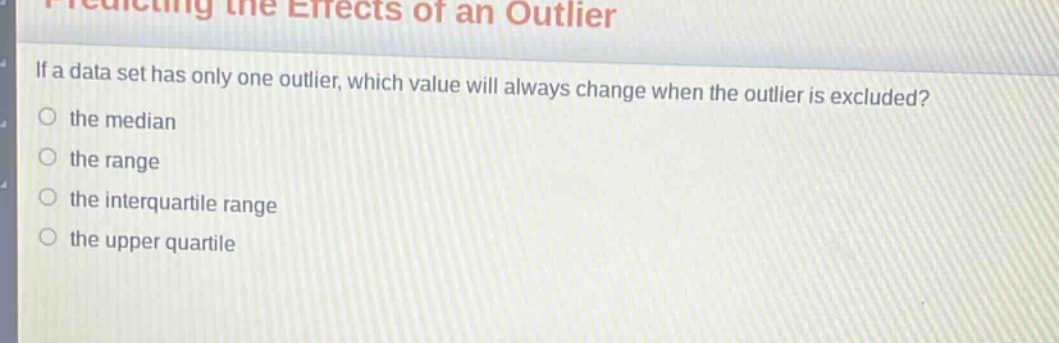
if a data set has only one outlier, which value will always change when the outlier is excluded?\n the median\n the range\n the interquartile range\n the upper quartile
Answer
Answer:
B. the range
Explanation:
Step1: Define range
The range is the difference between the maximum and minimum values in a data - set. An outlier is an extreme value. When the outlier (either the maximum or minimum value if it is an extreme value) is removed, the maximum or minimum value used to calculate the range changes. So the range will always change.
Step2: Analyze median
The median is the middle value. If the data - set has an odd number of data points and the outlier is not the middle value, or if the data - set has an even number of data points and the outlier does not affect the two middle values used to calculate the median, the median may not change.
Step3: Analyze inter - quartile range
The inter - quartile range (IQR) is the difference between the upper quartile (Q3) and the lower quartile (Q1). If the outlier is outside the range of Q1 and Q3, removing it may not change Q1 and Q3, so the IQR may not change.
Step4: Analyze upper quartile
The upper quartile is the value at the 75th percentile. If the outlier is above the upper quartile, removing it may not change the position of the 75th percentile value, so the upper quartile may not change.