if a data set has only one outlier, which value will always change when the outlier is excluded? the median…
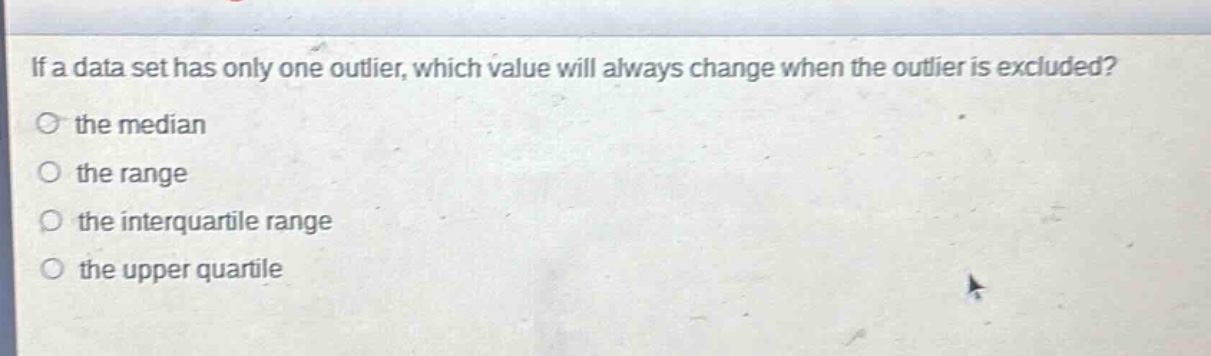
if a data set has only one outlier, which value will always change when the outlier is excluded? the median the range the interquartile range the upper quartile
Answer
Answer:
B. the range
Explanation:
Step1: Define range
The range is the difference between the maximum and minimum values in a data - set. An outlier is a value that is much larger or smaller than the other values. If the outlier is either the maximum or minimum value (which is common), when it is excluded, either the maximum or minimum value (or both) of the remaining data - set changes. So the range will always change.
Step2: Analyze median
The median is the middle value when the data is arranged in ascending or descending order. If the number of data points is odd and the outlier is not the middle value, or if the number of data points is even and the outlier is not one of the two middle - related values, the median may not change.
Step3: Analyze interquartile range
The interquartile range (IQR) is the difference between the upper quartile ($Q_3$) and the lower quartile ($Q_1$). The quartiles are based on the position of values in the ordered data - set. If the outlier is not in the lower 25% or upper 25% of the data (in terms of position), the IQR may not change.
Step4: Analyze upper quartile
The upper quartile ($Q_3$) is the value such that 75% of the data lies below it. If the outlier is not in the upper 25% of the data (in terms of position), the upper quartile may not change.