which data set has an outlier?\n6, 13, 13, 15, 15, 18, 18, 22\n4, 4, 4, 8, 9, 9, 11, 18\n2, 3, 5, 7, 8, 8…
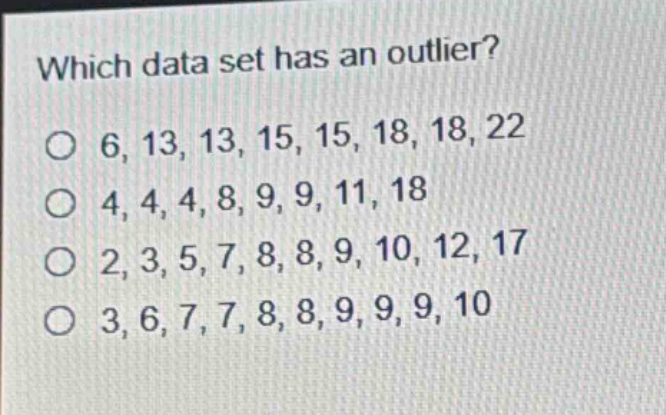
which data set has an outlier?\n6, 13, 13, 15, 15, 18, 18, 22\n4, 4, 4, 8, 9, 9, 11, 18\n2, 3, 5, 7, 8, 8, 9, 10, 12, 17\n3, 6, 7, 7, 8, 8, 9, 9, 9, 10
Answer
Explanation:
Step1: Calculate the inter - quartile range (IQR) for each data set
For a data set (x_1,x_2,\cdots,x_n) (sorted), the first quartile (Q_1) is the median of the lower half of the data, and the third quartile (Q_3) is the median of the upper half of the data. The inter - quartile range (IQR = Q_3 - Q_1). An outlier is a data point that is less than (Q_1-1.5IQR) or greater than (Q_3 + 1.5IQR).
Data set 1: (6,13,13,15,15,18,18,22)
- (n = 8). The lower half is (6,13,13,15), (Q_1=\frac{13 + 13}{2}=13). The upper half is (15,18,18,22), (Q_3=\frac{18+18}{2}=18). (IQR=18 - 13=5). (Q_1-1.5IQR=13-7.5 = 5.5), (Q_3 + 1.5IQR=18 + 7.5=25.5). All data points are within ([5.5,25.5]).
Data set 2: (4,4,4,8,9,9,11,18)
- (n = 8). The lower half is (4,4,4,8), (Q_1=\frac{4 + 4}{2}=4). The upper half is (9,9,11,18), (Q_3=\frac{9+11}{2}=10). (IQR=10 - 4=6). (Q_1-1.5IQR=4-9=-5), (Q_3 + 1.5IQR=10 + 9=19). The data point (18) is within ([-5,19]).
Data set 3: (2,3,5,7,8,8,9,10,12,17)
- (n = 10). The lower half is (2,3,5,7,8), (Q_1 = 5). The upper half is (9,10,12,17), (Q_3=12). (IQR=12 - 5=7). (Q_1-1.5IQR=5-10.5=-5.5), (Q_3 + 1.5IQR=12+10.5 = 22.5). The data point (2) is within ([-5.5,22.5]).
Data set 4: (3,6,7,7,8,8,9,9,9,10)
- (n = 10). The lower half is (3,6,7,7,8), (Q_1 = 7). The upper half is (8,9,9,9,10), (Q_3=9). (IQR=9 - 7=2). (Q_1-1.5IQR=7-3 = 4), (Q_3 + 1.5IQR=9+3=12). The data point (3) is less than (4).
Answer:
(3,6,7,7,8,8,9,9,9,10)