which data set has an outlier?\no 6,13,13,15,15,18,18,22\no 4,4,4,8,9,9,11,18\no 2,3,5,7,8,8,9,10,12,17\no…
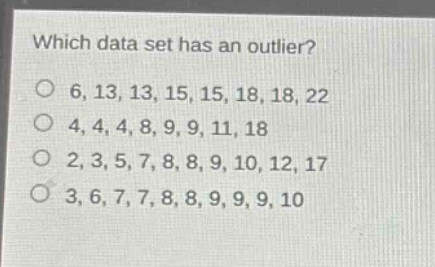
which data set has an outlier?\no 6,13,13,15,15,18,18,22\no 4,4,4,8,9,9,11,18\no 2,3,5,7,8,8,9,10,12,17\no 3,6,7,7,8,8,9,9,9,10
Answer
Explanation:
Step1: Recall outlier concept
An outlier is a data - point that is significantly different from the other data - points in a data set. One way to identify outliers is by looking for values that are far from the rest of the data.
Step2: Analyze the first data set
The data set (6,13,13,15,15,18,18,22) has values that are relatively close together. There are no extreme values.
Step3: Analyze the second data set
The data set (4,4,4,8,9,9,11,18). Most of the values are in the range (4 - 11), but the value (18) is much larger than the other values in the set. So, it is an outlier.
Step4: Analyze the third data set
The data set (2,3,5,7,8,8,9,10,12,17) has values that increase in a somewhat regular pattern. There are no values that are extremely different from the others.
Step5: Analyze the fourth data set
The data set (3,6,7,7,8,8,9,9,9,10) has values that are clustered together. There are no extreme values.
Answer:
(4,4,4,8,9,9,11,18)