which data sets have outliers? check all that apply.\n□ 14, 21, 24, 25, 27, 32, 35\n□ 15, 30, 35, 41, 44…
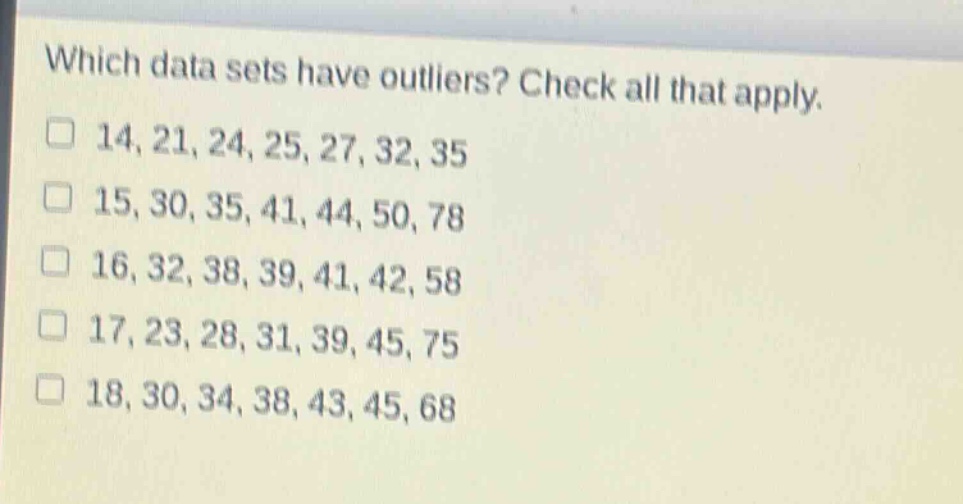
which data sets have outliers? check all that apply.\n□ 14, 21, 24, 25, 27, 32, 35\n□ 15, 30, 35, 41, 44, 50, 78\n□ 16, 32, 38, 39, 41, 42, 58\n□ 17, 23, 28, 31, 39, 45, 75\n□ 18, 30, 34, 38, 43, 45, 68
Answer
Explanation:
Step1: Recall outlier - finding method
We will use the inter - quartile range (IQR) method. First, find the first quartile ($Q_1$), third quartile ($Q_3$), and then calculate the IQR = $Q_3 - Q_1$. Outliers are values less than $Q_1-1.5\times IQR$ or greater than $Q_3 + 1.5\times IQR$.
Step2: For the data set 14, 21, 24, 25, 27, 32, 35
The number of data points $n = 7$. The median is the 4th value, so $M=25$. The lower half is 14, 21, 24, so $Q_1 = 21$. The upper half is 27, 32, 35, so $Q_3=32$. $IQR=32 - 21=11$. $Q_1-1.5\times IQR=21-1.5\times11=21 - 16.5 = 4.5$, $Q_3 + 1.5\times IQR=32+1.5\times11=32 + 16.5 = 48.5$. No values are outside this range, so no outliers.
Step3: For the data set 15, 30, 35, 41, 44, 50, 78
$n = 7$, median $M = 41$. Lower half: 15, 30, 35, $Q_1 = 30$. Upper half: 44, 50, 78, $Q_3=50$. $IQR=50 - 30 = 20$. $Q_1-1.5\times IQR=30-1.5\times20=30 - 30 = 0$, $Q_3 + 1.5\times IQR=50+1.5\times20=50 + 30 = 80$. No values are outside this range, so no outliers.
Step4: For the data set 16, 32, 38, 39, 41, 42, 58
$n = 7$, median $M = 39$. Lower half: 16, 32, 38, $Q_1 = 32$. Upper half: 41, 42, 58, $Q_3=42$. $IQR=42 - 32 = 10$. $Q_1-1.5\times IQR=32-1.5\times10=32 - 15 = 17$, $Q_3 + 1.5\times IQR=42+1.5\times10=42 + 15 = 57$. Since $58>57$, 58 is an outlier.
Step5: For the data set 17, 23, 28, 31, 39, 45, 75
$n = 7$, median $M = 31$. Lower half: 17, 23, 28, $Q_1 = 23$. Upper half: 39, 45, 75, $Q_3=45$. $IQR=45 - 23 = 22$. $Q_1-1.5\times IQR=23-1.5\times22=23 - 33=-10$, $Q_3 + 1.5\times IQR=45+1.5\times22=45 + 33 = 78$. Since $75<78$, no outliers.
Step6: For the data set 18, 30, 34, 38, 43, 45, 68
$n = 7$, median $M = 38$. Lower half: 18, 30, 34, $Q_1 = 30$. Upper half: 43, 45, 68, $Q_3=45$. $IQR=45 - 30 = 15$. $Q_1-1.5\times IQR=30-1.5\times15=30 - 22.5 = 7.5$, $Q_3 + 1.5\times IQR=45+1.5\times15=45 + 22.5 = 67.5$. Since $68>67.5$, 68 is an outlier.
Answer:
16, 32, 38, 39, 41, 42, 58; 18, 30, 34, 38, 43, 45, 68