which data sets have outliers? check all that apply. 14, 21, 24, 25, 27, 32, 35 15, 30, 35, 41, 44, 50, 78…
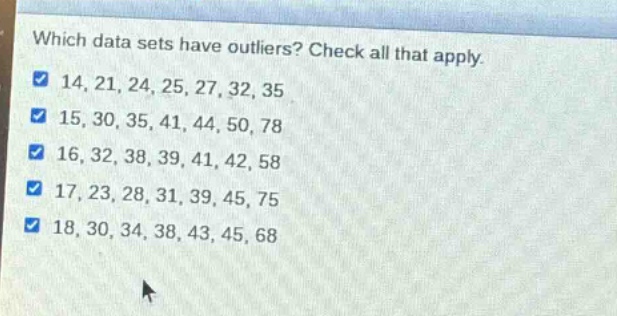
which data sets have outliers? check all that apply. 14, 21, 24, 25, 27, 32, 35 15, 30, 35, 41, 44, 50, 78 16, 32, 38, 39, 41, 42, 58 17, 23, 28, 31, 39, 45, 75 18, 30, 34, 38, 43, 45, 68
Answer
Explanation:
Step1: Recall outlier concept
Outliers are data - points that are far from other data points. One way to identify outliers is by using the inter - quartile range (IQR). But a simple visual inspection can also help. In a relatively evenly - spaced data set, a value that is much larger or smaller than the others is likely an outlier.
Step2: Analyze first data set
In the set 14, 21, 24, 25, 27, 32, 35, the values are relatively evenly spaced, no extreme values.
Step3: Analyze second data set
In the set 15, 30, 35, 41, 44, 50, 78, 78 is much larger than the other values, so it has an outlier.
Step4: Analyze third data set
In the set 16, 32, 38, 39, 41, 42, 58, 58 is relatively far from the other values, so it has an outlier.
Step5: Analyze fourth data set
In the set 17, 23, 28, 31, 39, 45, 75, 75 is much larger than the other values, so it has an outlier.
Step6: Analyze fifth data set
In the set 18, 30, 34, 38, 43, 45, 68, 68 is much larger than the other values, so it has an outlier.
Answer:
15, 30, 35, 41, 44, 50, 78; 16, 32, 38, 39, 41, 42, 58; 17, 23, 28, 31, 39, 45, 75; 18, 30, 34, 38, 43, 45, 68