the data in the table represents the predicted price of a gallon of milk, y, for number of years, x.\nprice…
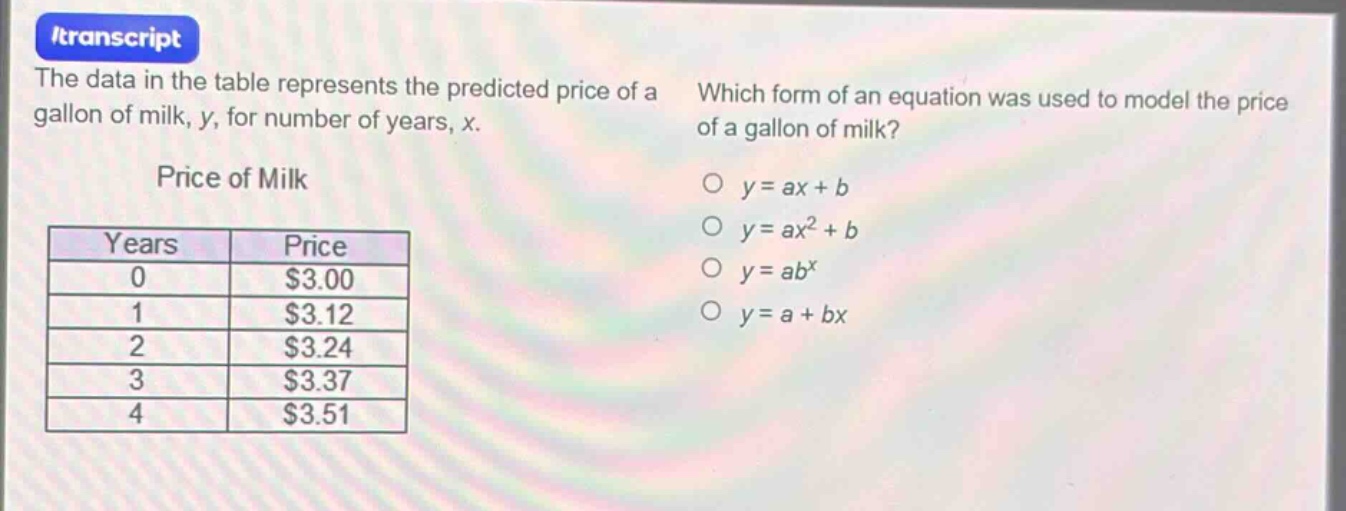
the data in the table represents the predicted price of a gallon of milk, y, for number of years, x.\nprice of milk\n| years | price |\n| ---- | ---- |\n| 0 | $3.00 |\n| 1 | $3.12 |\n| 2 | $3.24 |\n| 3 | $3.37 |\n| 4 | $3.51 |\nwhich form of an equation was used to model the price of a gallon of milk?\no y = ax + b\no y = ax^2 + b\no y = ab^x\no y = a + bx
Answer
Explanation:
Step1: Analizar la forma general de las ecuaciones
Tenemos cuatro opciones de ecuaciones: $y = ax + b$ (lineal), $y=ax^{2}+b$ (cuadrática), $y = ab^{x}$ (exponencial) y $y=a + bx$ (también lineal).
Step2: Calcular las diferencias entre los valores de $y$
Para $x = 0,y = 3.00$; para $x = 1,y = 3.12$; para $x = 2,y = 3.24$; para $x = 3,y = 3.37$; para $x = 4,y = 3.51$. Las diferencias son: $3.12 - 3.00=0.12$, $3.24 - 3.12 = 0.12$, $3.37 - 3.24=0.13$, $3.51 - 3.37 = 0.14$. Las diferencias son aproximadamente constantes, lo que sugiere una ecuación lineal.
Step3: Identificar la forma correcta
Las ecuaciones lineales son $y = ax + b$ y $y=a + bx$, que son equivalentes. La forma más común es $y = ax + b$.
Answer:
$y = ax + b$